Careful observation is important because some carbonate minerals react vigorously and others barely react with cold acid.
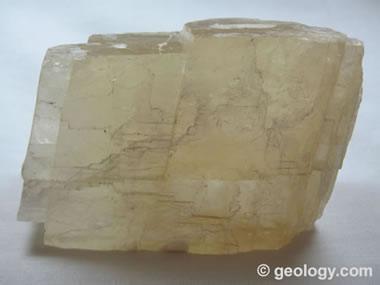
The carbonate mineral that is most commonly encountered by geologists is calcite (CaCO3). Calcite is a “ubiquitous” mineral. Ubiquitous means “found everywhere.” Calcite occurs in igneous, metamorphic, and sedimentary rocks and is the most commonly encountered carbonate mineral. If you place one drop of cold hydrochloric acid on calcite, the entire drop of acid will erupt with bubbles and a vigorous fizz will last for a few seconds.
Dolomite CaMg(CO3)2 is another commonly encountered carbonate mineral. If you place one drop of cold hydrochloric acid on a piece of dolomite, the reaction is weak or not observed. Instead of seeing an obvious fizz, you will see a drop of acid on the surface of the mineral that might have a few bubbles of carbon dioxide gas slowly growing on the dolomite surface.
However, if warm acid is placed on dolomite, an obvious fizz will occur. This occurs because the acid and rock react more vigorously at higher temperatures.
If you place a drop of hydrochloric acid on powdered dolomite, a visible reaction will occur. This is because the surface area has been increased, making more dolomite available to the acid. (You can easily make dolomite powder by scratching a specimen of dolomite across a streak plate. Then test the powder by placing a drop of hydrochloric acid on the powder. Another easy way to produce a small amount of mineral powder is to scratch the specimen with a nail.)
Different carbonate minerals have different responses to hydrochloric acid. A list of common and occasionally encountered carbonate minerals is given in Table 1 with their chemical composition and their relative reaction with cold and warm hydrochloric acid.
When a mineral has a weak response to acid, you must be observant and patient to see it. For example, magnesite has a very weak reaction with cold HCl. If you powder a small amount of magnesite on a streak plate and place a drop of acid on it, you might not see any action for several seconds. Then, as tiny bubbles begin to form on particles of magnesite, the drop of acid will appear to grow larger in size. That occurs as carbon dioxide is liberated from the mineral and displaces the water. Observing the formation of bubbles with a hand lens can be helpful.
| Acid Reactions of Carbonate Minerals | |||
| Mineral | Chemical Composition | Cold Acid Reaction | Warm Acid Reaction |
| Aragonite | CaCO3 | strong | strong |
| Azurite | Cu3(CO3)2(OH)2 | yes | strong |
| Calcite | CaCO3 | strong | strong |
| Dolomite | CaMg(CO3)2 | weak | yes |
| Magnesite | MgCO3 | very weak | weak |
| Malachite | Cu2CO3(OH)2 | yes | yes |
| Rhodochrosite | MnCO3 | weak | yes |
| Siderite | FeCO3 | very weak | weak |
| Smithsonite | ZnCO3 | weak | yes |
| Strontianite | SrCO3 | yes | yes |
| Witherite | BaCO3 | weak | weak |
| Table 1: A list of commonly and occasionally encountered carbonate minerals with their chemical formula and reactions to cold and warm hydrochloric acid. Test results can vary because of weathering, previous testing, contamination, and specimen purity. |