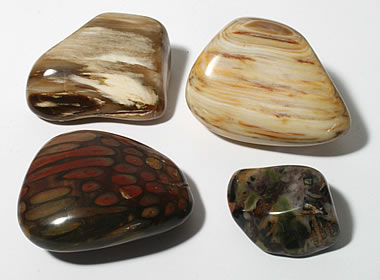
The most popular materials used for making tumbled stones are attractive and colorful rocks and minerals that have a Mohs hardness between 5 and 8. These materials are generally durable and accept a good polish. Some of the most commonly tumbled materials are listed below.
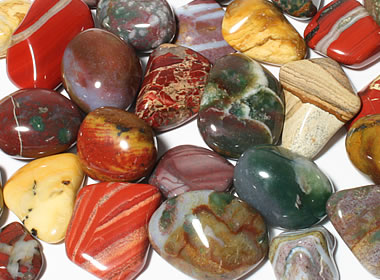
Varieties of Chalcedony
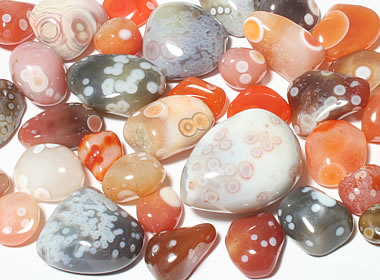
- Agate (a translucent, banded variety of microcrystalline quartz)
- Bloodstone (a green jasper with bright red markings that resemble blood splatter)
- Jasper (an opaque variety of microcrystalline quartz with abundant mineral inclusions)
Varieties of Crystalline Quartz
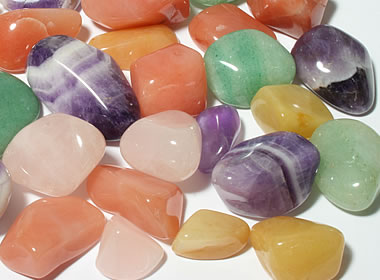
- Amethyst (a transparent purple quartz that sometimes has color-zoning or banding)
- Aventurine (a translucent quartz with abundant reflective mineral inclusions)
- Citrine (a transparent yellow to orange quartz)
- Orange Quartz
- Rock Crystal (transparent quartz)
- Rose Quartz (pink quartz)
- Smoky Quartz (a transparent brown quartz)
- Tiger’s-Eye (crystalline quartz that has replaced crocidolite)
- Yellow Quartz
Minerals
- Amazonite (a green variety of microcline feldspar)
- Beryl (the mineral of aquamarine, emerald, and heliodor)
- Chrysocolla (a blue to green copper mineral usually in quartz)
- Fluorite (a colorful mineral composed of calcium and fluorine)
- Garnet (a popular gem mineral that occurs in a variety of colors)
- Hematite (a silver metallic ore of iron)
- Labradorite (a variety of plagioclase feldspar with an iridescent luster)
- Malachite (a green banded mineral composed of copper carbonate)
- Moonstone (a variety of feldspar that displays adularescence)
- Nephrite (a variety of jade)
- Orthoclase (a white to pink to gray feldspar mineral)
- Rhodonite (a pink magnesium mineral)
- Sodalite (a blue silicate mineral)
- Sunstone (specimens of labradorite feldspar with reflective mineral inclusions)
- Turquoise (a greenish blue copper mineral)
Rocks
- Basalt (a black, fine-grained igneous rock)
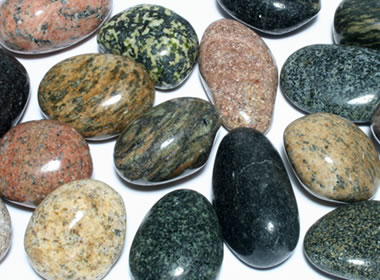
- Granite (a coarse-grained igneous rock of quartz and feldspar)
- Lapis lazuli (a blue metamorphic rock)
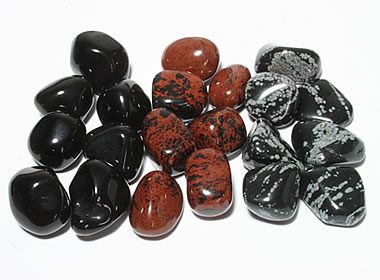
- Obsidian (a volcanic glass)
- Picasso Stone (a dolomite with markings that resemble the paintings of Picasso)
- Quartzite (a metamorphic rock composed of quartz)
- Rhyolite (a fine-grained volcanic rock)
- Unakite (a granitic igneous rock containing pink orthoclase and green epidote)
Fossil Materials
- Mookaite (a colorful radiolarite)
- Petrified Wood (fossil wood, preserved by replacement and infilling by chalcedony)
- Silicified Coral (a coral preserved by replacement and infilling by chalcedony)
- Turritella (a brown agate that contains abundant gastropod fossils)