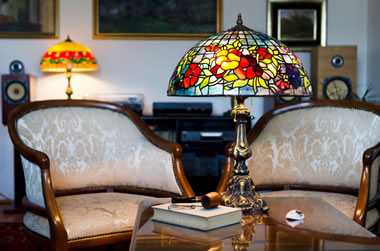
The recipe for producing colored glass usually involves the addition of a metal to the glass. This is often accomplished by adding some powdered oxide, sulfide, or other compound of that metal to the glass while it is molten. The table below lists some of the coloring agents of glass and the colors that they produce. Manganese dioxide and sodium nitrate are also listed. They are decoloring agents – materials that neutralize the coloring impact of impurities in the glass.
| Metals Used to Impart Color to Glass | |
| Cadmium Sulfide | Yellow |
| Gold Chloride | Red |
| Cobalt Oxide | Blue-Violet |
| Manganese Dioxide | Purple |
| Nickel Oxide | Violet |
| Sulfur | Yellow-Amber |
| Chromic Oxide | Emerald Green |
| Uranium Oxide | Fluorescent Yellow, Green |
| Iron Oxide | Greens and Browns |
| Selenium Oxide | Reds |
| Carbon Oxides | Amber-Brown |
| Antimony Oxides | White |
| Copper Compounds | Blue, Green, Red |
| Tin Compounds | White |
| Lead Compounds | Yellow |
| Manganese Dioxide | A “decoloring” agent |
| Sodium Nitrate | A “decoloring” agent |