Basalt is a dark-colored, fine-grained, igneous rock composed mainly of plagioclase and pyroxene minerals. It most commonly forms as an extrusive rock, such as a lava flow, but can also form in small intrusive bodies, such as an igneous dike or a thin sill. It has a composition similar to gabbro. The difference between basalt and gabbro is that basalt is a fine-grained rock while gabbro is a coarse-grained rock.
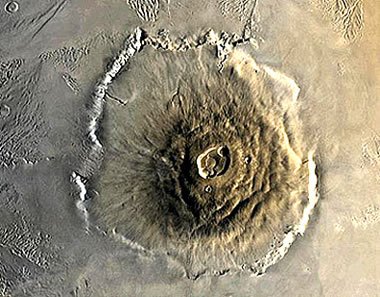
Olympus Mons Volcano: This shield volcano is composed of basalt and has enormous calderas at the summit. Olympus Mons is the highest topographic feature on Mars and is the largest known volcano in our solar system. It is about 375 miles (600 kilometers) in diameter and 15 miles (25 kilometers) high. NASA Mars Orbiter Camera image.
Earth’s Most Abundant Bedrock
Basalt underlies more of Earth’s surface than any other rock type. Most areas within Earth’s ocean basins are underlain by basalt. Although basalt is much less common on continents, lava flows and flood basalts underlie several percent of Earth’s land surface. Basalt is a very important rock.
Basalt on Moon and Mars
Basalt is also an abundant rock on the Moon. Much of the Moon’s surface is underlain by basaltic lava flows and flood basalts. These areas of the Moon are known as “lunar maria.” Large areas of the Moon have been resurfaced by extensive basalt flows which may have been triggered by major impact events. The ages of lunar maria can be estimated by observing the density of impact craters on their surface. Younger basalt flows will have fewer craters.