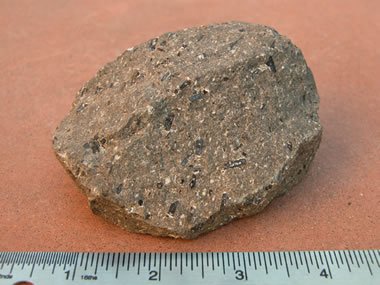
Occasionally, andesites contain large, visible grains of plagioclase, amphibole, or pyroxene. These large crystals are known as “phenocrysts.” They begin forming when a magma, which is cooling at depth, approaches the crystallization temperature of some of its minerals. These high-crystallization-temperature minerals begin forming below the surface and grow to visible sizes before the magma erupts.
When the magma erupts onto the Earth’s surface, the rest of the melt crystallizes quickly. This produces a rock with two different crystal sizes: large crystals that formed slowly at depth (the “phenocrysts”), and small crystals that formed quickly at the surface (known as “groundmass”).
“Andesite porphyry” is the name used for these rocks with two crystal sizes. The name of an abundant phenocryst mineral may be used as an adjective to the rock name. An example is the hornblende andesite porphyry shown in the accompanying photo.