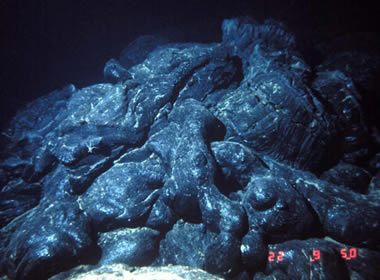
Most of Earth’s basalt is produced at divergent plate boundaries on the mid-ocean ridge system (see map). Here convection currents deliver hot rock from deep in the mantle. This hot rock melts as the divergent boundary pulls apart, and the molten rock erupts onto the sea floor. These submarine fissure eruptions often produce pillow basalts as shown in the image on this page.
The active mid-ocean ridges host repeated fissure eruptions. Most of this activity is unnoticed because these boundaries are under great depths of water. At these deep locations, any steam, ash, or gas produced is absorbed by the water column and does not reach the surface. Earthquake activity is the only signal to humans that many of these deep ocean ridge eruptions provide. However, Iceland is a location where a mid-ocean ridge has been lifted above sea level. There, people can directly observe this volcanic activity.