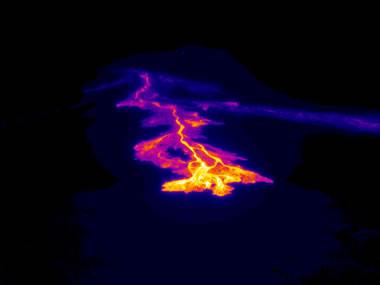
Another location where significant amounts of basalt are produced is above oceanic hotspots. These are locations (see map above) where a small plume of hot rock rises up through the mantle from a hotspot on Earth’s core. The Hawaiian Islands are an example of where basaltic volcanoes have been built above an oceanic hotspot.
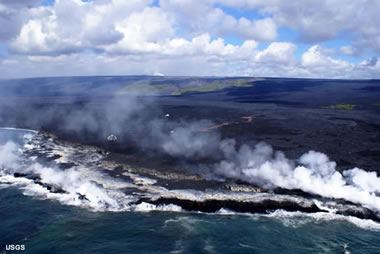
Basalt production at these locations begins with an eruption on the ocean floor. If the hotspot is sustained, repeated eruptions can build the volcanic cone larger and larger until it becomes high enough to become an island. All of the islands in the Hawaiian Island chain were built up from basalt eruptions on the sea floor.
The island that we know today as “Hawaii” is thought to be between 300,000 and 600,000 years old. It began as an eruption on the floor of the Pacific Ocean. The volcanic cone grew as recurrent eruptions built up layer after layer of basalt flows. About 100,000 years ago it is thought to have grown tall enough to emerge from the ocean as an island.
Today it consists of five overlapping volcanoes. Kilauea is the most active of these volcanoes. It has been in amost continuous eruption since January, 1983. Basalt flows from Kilauea have extruded over one cubic mile of lava, which currently covers about 48 square miles of land. These flows have travelled over seven miles to reach the ocean, covering highways, homes and entire subdivisions that were in their path.