Plumes & Hotspots Below Continents


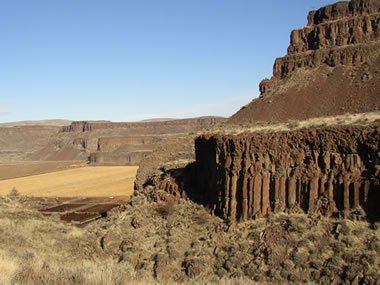
The third basalt-forming environment is a continental environment where a mantle plume or hotspot delivers enormous amounts of basaltic lava through the continental crust and up to Earth’s surface. These eruptions can be from either vents or fissures. They have produced the largest basalt flows on the continents. The eruptions can occur repeatedly over millions of years, producing layer after layer of basalt stacked in a vertical sequence (see outcrop photo).

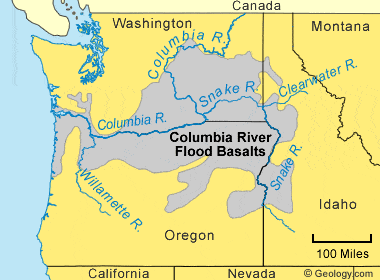
The Columbia River Flood Basalts in Washington, Oregon, and Idaho are an example of extensive flood basalts on land (see map below). Other examples include the Emeishan Traps of China, the Deccan Traps of India, the Keweenawan Lavas of the Lake Superior region, the Etendeka Basalts of Namibia, the Karroo Basalts of South Africa, and the Siberian Traps of Russia. (The word “traps” is derived from the Swedish word for “stairs,” which describes the outcrop profile of these layered basalt deposits, as shown in the outcrop photo.)
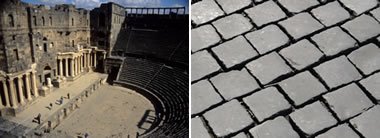
Basalt uses
The Roman theatre: (left) in Bosra, Syria. The dark building stone is basalt. Image copyright iStockphoto / Steve Estvanik.
Basalt paving stones: (right) on a city street in Rome, Italy. Basalt pavers were often used in areas close to volcanoes.
Columbia River Flood Basalts
Columbia River Flood Basalts: The Columbia River Flood Basalts are an extensive sequence of stacked lava flows that reach a cumulative thickness of up to 6000 feet. The outcrops in the foreground and in the distance of this photo are all made up of layered basalt flows. Although basalt is typically a dark black rock, it often weathers to a yellow-brown color similar to the rocks shown here. Public domain image by Williamborg.
Columbia River Flood Basalts Map
Columbia River Flood Basalts Map: A map of the area underlain by the Columbia River Flood Basalts in Washington, Oregon, and Idaho. The area shown is what has not yet been eroded away – the original extent of these basalt flows was much greater. Over 300 individual flows have been identified, and several hundred meters of basalt underlies much of the area shown in the map above.

Leave a Reply

Your email address will not be published. Required fields are marked *