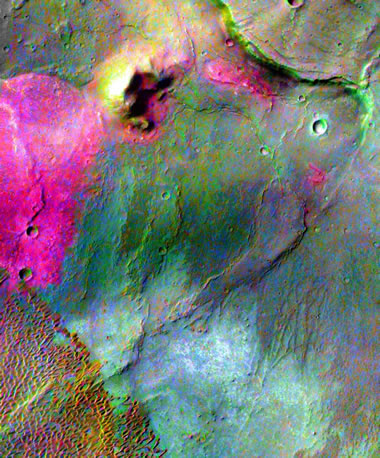
In 2002, NASA’s THEMIS spacecraft began orbiting Mars, scanning the surface of the planet with a thermal emission imaging system. Instruments on the spacecraft had the ability to characterize the mineralogy of rock units exposed on the surface of Mars. Their goals were to identify the rock types on the surface of Mars and map their geographic distribution.
THEMIS identified basalt as the primary volcanic rock exposed on the Martian surface. Syrtis Major is an 800 mile (1300 kilometer) wide basaltic volcano near the Martian equator. It has several collapse calderas at its summit and numerous volcanic vents on its flanks. The flank eruptions have produced a sequence of glassy, silica-rich dacite flows. These have built cones up to 1000 feet (300 meters) high, with lava flows that travelled up to 12 miles (20 kilometers) from their vents.
Many of the volcanic rocks observed on Syrtis Major were dacites and obsidians, similar to terrestrial volcanoes such as Mount Hood in the United States and Mount Fuji in Japan. The existence of dacite on Mars is evidence that highly evolved magmas have formed on Mars, and they were created by processes such as partial melting and fractional crystallization.