Breccia forms where broken, angular fragments of rock or mineral debris accumulate. One of the most common locations for breccia formation is at the base of an outcrop where mechanical weathering debris accumulates. Another is in stream deposits a short distance from the outcrop or on an alluvial fan.
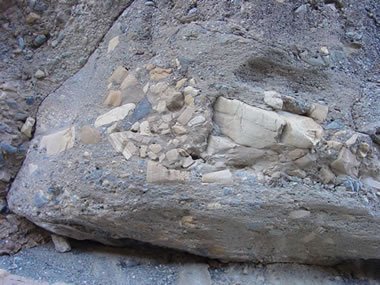
Some breccias form from debris flow deposits. The angular particle shape reveals that they have not been transported very far (transport wears the sharp points and edges of angular particles into rounded shapes). After deposition, the fragments are bound together by a mineral cement or by a matrix of smaller particles that fills the spaces between the fragments.
In arid and semiarid areas, the precipitation of mineral cements in shallow sediments or soils can result in the formation of extensive rock units known as “caliche.” These materials often have the appearance of breccia and fit the definition.