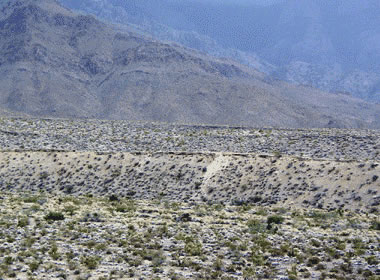
Caliche has a diversity of origins. The major process of forming caliche begins when calcium carbonate is leached from upper soil horizons by downward-percolating solutions. Dissolved calcium carbonate might also be delivered to the site in runoff and then percolate into the soil. The calcium carbonate then precipitates in a deeper soil horizon to form the caliche layer.
At first the calcium carbonate precipitates as small grains or thin coatings on sediment grains or soil particles. As the grain coatings thicken, adjacent grains will be cemented together, and nodules consisting of multiple grains and their surrounding cement will form. As cementing continues, a continuous subsurface layer might form.
In an advanced stage, a solid caliche layer can develop. These can become so dense and impermeable that they can resist the downward percolation of water and erosion by wind or water. The caliche layer generally has a higher density at the top and decreases downward. Advanced caliche formation can produce a layer that is over one meter thick and have a lateral extent of hundreds of square kilometers or more.
Some caliche forms by the upward movement of water through capillary action. As the water evaporates, dissolved materials precipitate, and, over time, can cement the soil or sediment.
Caliche can also form beneath vegetation that extracts water from the ground and transpires it into the atmosphere. As large amounts of water are removed by the plants, mineral materials that the plants do not remove become concentrated in the subsurface waters. When the concentration becomes high enough, or evaporation occurs, precipitation begins and can form caliche over time.