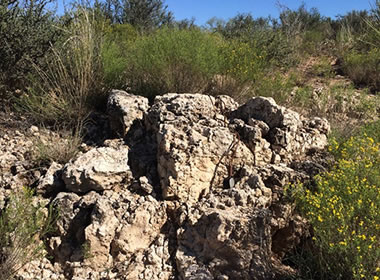
The presence of caliche in a soil or sediment has many practical implications. These might include:
- Caliche can be a barrier to the downward infiltration of water.
- Caliche can be a barrier to erosion by wind or water. When it is breached, downward erosion can be rapid, channeled and severe.
- Caliche can be extremely durable and present problems at construction sites.
- Caliche layers in terraced sediments can strongly influence topography.
- Caliche layers in aquifers can result in the stratified flow of groundwater.
- Caliche development can incorporate gold, gemstones, and other valuable minerals.
- Caliche porosity can serve as the deposition site of valuable secondary minerals, including ores of uranium and vanadium, and gem materials such as turquoise and malachite.
- Caliche deposits are sometimes correlated and used as relative age and stratigraphic markers.
- Caliche development indicates a time interval of tectonic, sedimentary, erosional and hydrologic stability.
- Caliche is often a challenge to agriculture. It interferes with proper soil drainage, the formation of plant roots, and it also can contain soluble minerals that are not beneficial to the plants.
- Caliche is sometimes crushed and used as fill, aggregate, or as a raw material for making portland cement. It is usually used when higher grade materials are not available or when minimal quality material is sufficient.