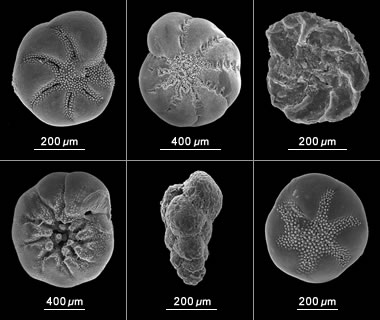
Chalk forms from a fine-grained marine sediment known as ooze. When foraminifera, marine algae, or other organisms living on the bottom or in the waters above die, their remains sink to the bottom and accumulate as ooze. If most of the accumulating organic debris consists of calcium carbonate, then chalk will be the type of rock that forms from the ooze. However, if the accumulating organic debris comes from diatoms and radiolarians, the ooze will consist mainly of silica, and the rock type that forms will be diatomite.
Extensive deposits of chalk are found in many parts of the world. They often form in deep water where clastic sediments from streams and beach action do not dominate the sedimentation. They can also form in epeiric seas on continental crust and on the continental shelf during periods of high sea level.
Chalk is widely known among the people of western Europe and a few other parts of the world because it is a bright white rock that can form vertical cliffs along shorelines. The chalk cliffs are eroded at water level by wave action, and as the base of the cliff is undercut, collapses occur when the undercutting reaches a vertical joint or other plane of weakness.
The spectacular cliffs on both sides of the English Channel are composed of chalk. They are known as the “White Cliffs of Dover” on the United Kingdom side of the Channel and the Cap Blanc-Nez along the coast of France. The English Channel Tunnel, nicknamed “The Chunnel”, that connects England and France was bored through the West Melbury Marly Chalk, a thick and extensive chalk unit that underlies the area.