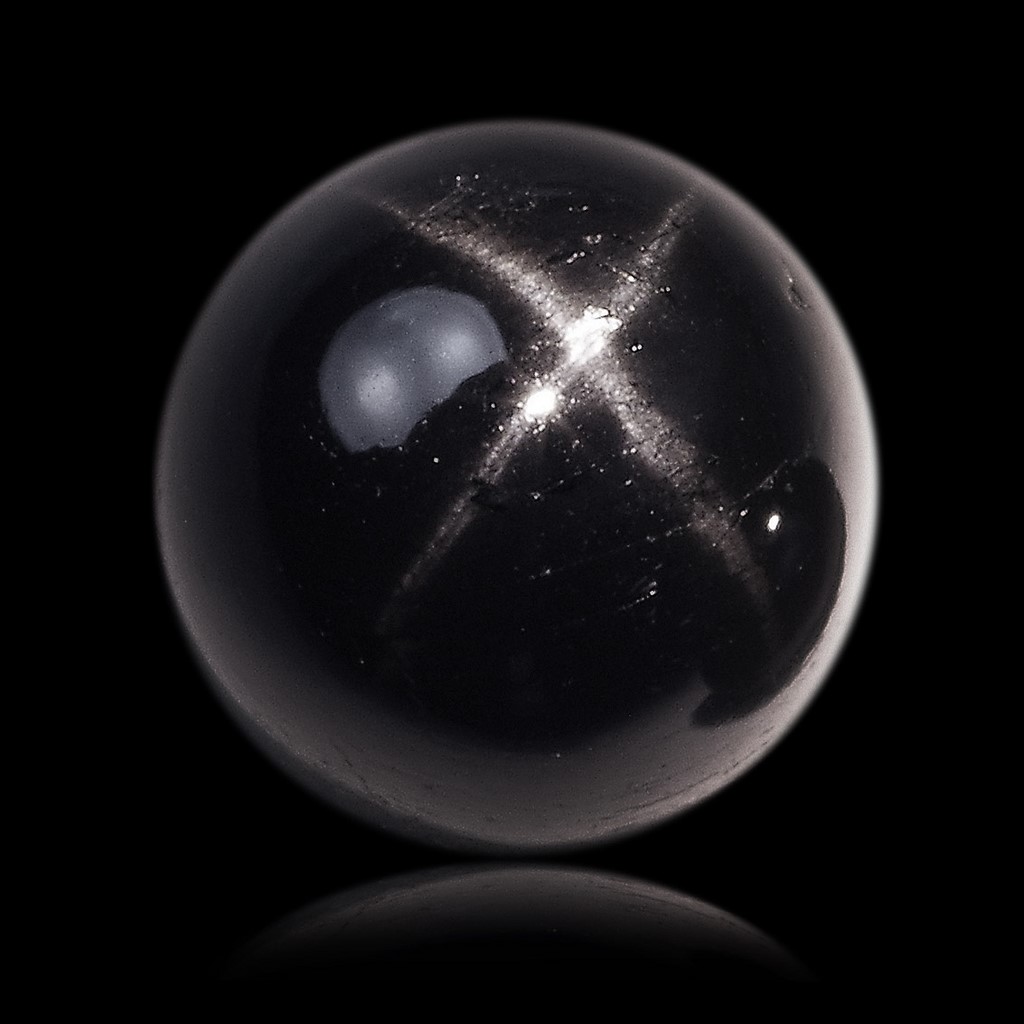
Some diopside crystals are filled with microscopic needle-shaped inclusions that occur in a parallel alignment through the crystal structure of the mineral. This network of parallel inclusions is known as a “silk.” When this diopside is cut en cabochon, the parallel needles of the silk can reflect light much like how light is reflected from a spool of silk thread.
A silk with one direction of needle alignment will produce chatoyance, also known as a cat’s eye. Silk with two or three directions of needle alignment will produce asterism. Two directions will produce a four-ray star, and three directions will produce a six-ray star.
In star diopside there are two directions of needle alignment, producing a four-ray star. The star is often strong and straight in one direction but weaker and slightly wavy in the second. A thin white or silver star on a jet-black cabochon is characteristic of star diopside.
For the star phenomenon to appear, the rough must be oriented so both silk directions and the flat bottom of the cabochon are all aligned in the same plane. In addition, the top of the cabochon must be symmetrically cut. Without this precise cutting, the star will be off-center. If the directions of the star do not intersect at 90 degrees, it is not a result of poor orientation of the rough during cutting. The directions of the silk do not intersect at precisely 90 degrees.
The mineral needles that form the silk are known in some instances to be magnetite. They are sometimes abundant enough to make the cut gems slightly magnetic. If you approach them slowly with a magnet, the gems will move before the magnet touches them. The needles in some non-magnetic gems can be rutile or ilmenite. A silk made up of heavy mineral crystals will give star diopside a higher specific gravity than other specimens of diopside.
Star diopside is one of the least expensive gems with obvious asterism. Small cabochons (6 or 8 millimeters) with a clear star can often be purchased for under $30. Larger stones or those with exceptional stars will sell for a lot more. They are a nice way to obtain a star gem without paying the high cost of star sapphire.
Star diopside has a hardness of just 5 1/2. This makes it easy to scratch if used in a ring, bracelet, or cufflinks. Small stones are best used as earrings. Rare large stones can make nice pendants.