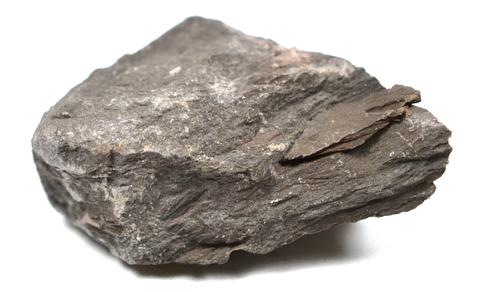
Hornfels is a fine-grained metamorphic rock that was subjected to the heat of contact metamorphism at a shallow depth. It was “baked” by heat conducted from a nearby magma chamber, sill, dike, or lava flow. Common temperatures for the formation of hornfels range from about 1300 to 1450 degrees Fahrenheit (700 to 800 degrees Celsius).
Because directed pressure does not play a significant role in the formation of hornfels, it is often made up of mineral grains that are equidimensional in shape and without a preferred orientation. The grain shape and orientation might also be inherited from its parent rock.
The name “hornfels” is assigned to a rock after considering its grain size, texture, and geologic history. As a result, hornfels does not have a specific chemical or mineralogical composition. It inherits its composition from the rocks that are metamorphosed plus the fluids involved in the metamorphic process. Interpreting composition, grain size, texture, and geologic history can make hornfels a very difficult rock to identify.