Conglomerate and breccia are similar rocks. They are both made of clasts over two millimeters in diameter. What’s the difference between conglomerate and breccia?
The difference is in the shape of the clasts. Conglomerate is made up mostly of subrounded to rounded clasts. However, breccia is made up mostly of subangular to angular clasts.
Sedimentary clasts can be angular or rounded. What determines the difference? They both start out at an outcrop (a location where a rock unit is exposed at Earth’s surface). This outcrop is known as the “source area” for the clasts.
In the source area, chemical and physical weathering act upon the rock, causing it to break or disintegrate into smaller pieces. These pieces are usually subangular to angular. If the clasts accumulate near the outcrop and form into a rock, that rock will have angular pieces and be a breccia.
However, if the pieces are transported by a stream or the action of waves, the clasts will be abraded against one another and against other clasts on the bottom of the stream. That abrasion will – over time – cause their angular shapes to become subrounded to rounded. If the rounded clasts are deposited and formed into a rock, that rock with rounded clasts will be a conglomerate.
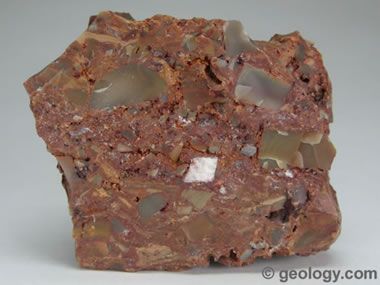
The difference between conglomerate and breccia is in the transportation history of their clasts.