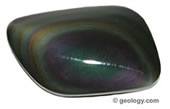
 Rainbow Obsidian: A baroque cabochon of iridescent “rainbow obsidian.” |
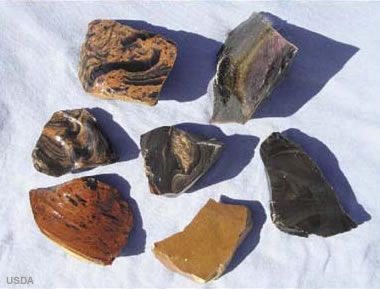
Black is the most common color of obsidian. However, it can also be brown, tan, or green. Rarely, obsidian can be blue, red, orange, or yellow. The colors are thought to be caused mainly by trace elements or inclusions.
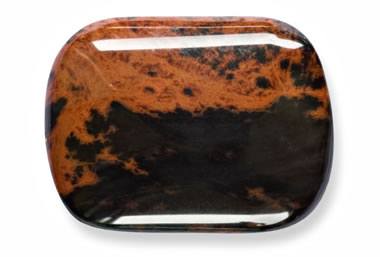
Occasionally two colors of obsidian will be swirled together in a single specimen. The most common color combination is black and brown obsidian swirled together – that’s called “mahogany obsidian”
As a “glass,” obsidian is chemically unstable. With the passage of time, some obsidian begins to crystallize. This process does not happen at a uniform rate throughout the rock. Instead it begins at various locations within the rock. At these locations, the crystallization process forms radial clusters of white or gray cristobalite crystals within the obsidian. When cut and polished, these specimens are referred to as “snowflake obsidian” (see photos).
Rarely, obsidian has an iridescent or metallic “sheen” caused by light reflecting from minute inclusions of mineral crystals, rock debris, or gas. These colored specimens are known as “rainbow obsidian,” “golden obsidian,” or “silver obsidian,” depending upon the color of the sheen or iridescence. These specimens are very desirable for the manufacture of jewelry.