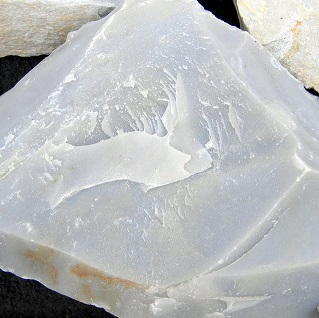
Novaculite is a dense, hard, fine-grained siliceous rock that breaks with a conchoidal fracture. It forms from sediments deposited in marine environments where organisms such as diatoms (single-celled algae that secrete a hard shell composed of silicon dioxide) are abundant in the water. When the diatoms die, their silicon dioxide shells fall to the seafloor. In some areas these diatom shells are the primary ingredient of the seafloor sediments.
During diagenesis (the transformation from sediment to rock) the silicon dioxide from the diatom shells is transformed into chalcedony (a microcrystalline silicon dioxide). At this point the rock is chert. The chert is transformed into novaculite as further diagenesis and low-grade metamorphism recrystallize the chalcedony into microcrystalline quartz grains.
The two primary differences between chert and novaculite are: 1) chert is composed mainly of chalcedony while novaculite is composed mainly of microcrystalline quartz grains; and, 2) chert is a sedimentary rock, while novaculite is a chert that has experienced a higher level of diagenetic alteration and low-grade metamorphism.