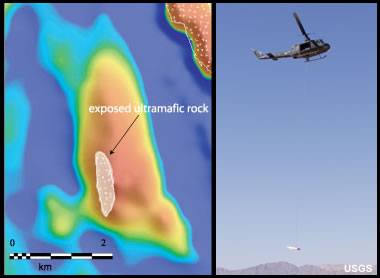
Peridotite bodies exposed at Earth’s surface are rapidly attacked by weathering. They can then be obscured by soil, sediment, glacial till, and vegetation. Finding a peridotite body as small as a kimberlite pipe, which might be only a few hundred yards across, can be very difficult. Because peridotite often has magnetic properties that are distinctly different from the surrounding rocks, a magnetic survey can sometimes be used to locate them. The survey can be conducted using an aircraft that slowly tows a magnetometer at low altitudes, recording the magnetic intensity as it travels. The magnetic data can be plotted on a map, often revealing the location of the pipe as an anomaly. (See map and photo.)
Peridotite bodies are also found by prospecting for some of the rare minerals that they contain. When a peridotite weathers, the olivine breaks down, quickly leaving the more resistant minerals behind. Geologists have located peridotite bodies by prospecting for chromite, garnet, and other resistant indicator minerals. When scattered by the action of water, wind, or ice, they will be most highly concentrated near the pipe and be diluted by local rock debris with distance. The grains of these minerals might also be more rounded with distance of transport. This allows geologists to use the “trail-to-lode” prospecting method to find them.