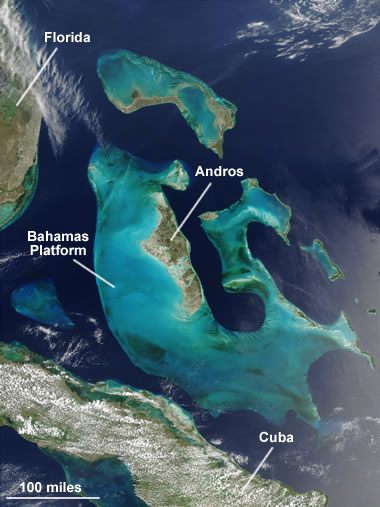
Some limestones form by direct precipitation of calcium carbonate from marine or fresh water. Limestones formed this way are chemical sedimentary rocks. They are thought to be less abundant than biological limestones.
Most biological limestones contain significant amounts of directly precipitated calcium carbonate. After the biological grains have accumulated and are buried, water that is saturated with dissolved materials moves slowly through the sediment mass. Calcium carbonate, precipitated directly from solution, forms as a “cement” that binds the biological grains together.
“Cementation” is an important step in the transformation of a sediment into a rock. If the biological grains are not cemented together, a rock will not be formed. The amount of precipitated calcium carbonate in a biological limestone can be as low as a few percent of the rock by volume, or it can be higher than 50% of the rock by volume.