There are many different types of limestone – each with its own name. These names are often based upon how the rock formed, its appearance, its composition, or its physical properties. Here are some of the more commonly encountered types of limestone.
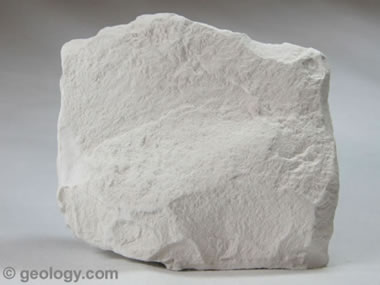
Chalk
Chalk is the name of a limestone that forms from an accumulation of calcareous shell remains of microscopic marine organisms such as foraminifera. It can also form from the calcareous remains of some marine algae.
Chalk is a friable limestone with a very fine texture, and it is easily crushed or crumbled. It is usually white or light gray in color.
In the past pieces of natural chalk were used to write on blackboards. Today, most blackboard chalk is a man-made product. Some of it is made from natural chalk along with additives that improve its performance.
Coquina
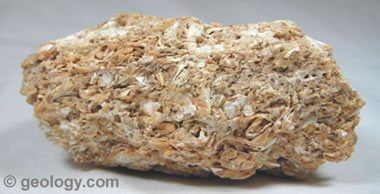
Coquina is the name of a poorly cemented limestone composed almost exclusively of sand-size fragments of calcareous shell and/or coral debris. A small amount of calcareous cement usually binds the grains together.
The sediments that form coquina accumulate on beaches where wave action delivers an abundance of locally produced biological grains, while a significant amount of other material is not deposited. Coquina might be composed of mollusk, gastropod, brachiopod, trilobite, coral, ostracod or other invertebrate remains.
Crystalline Limestone
When limestone is subjected to heat, pressure, and chemical activity, the calcite in the rock begins to transform. This is the beginning of the process known as metamorphism.
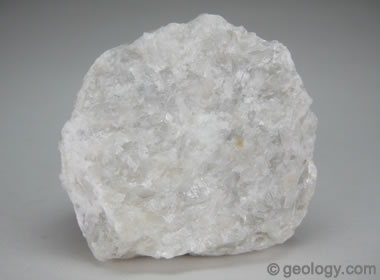
Starting at a microscopic scale, the calcium carbonate in the rock begins to crystallize or recrystallize into fine-grained calcite crystals. As the duration and intensity of metamorphism continues, the calcite crystals increase in size. When the calcite crystals are large enough to be visible to the eye, the rock can then be recognized as marble – a metamorphic rock.
Marble is the name of the metamorphic rock that forms when limestone is subjected to the heat and pressure of metamorphism. It is composed of calcium carbonate (CaCO3) and usually contains other minerals that might include clay minerals, micas, quartz, pyrite, iron oxide, and graphite.
Dolomitic Limestone
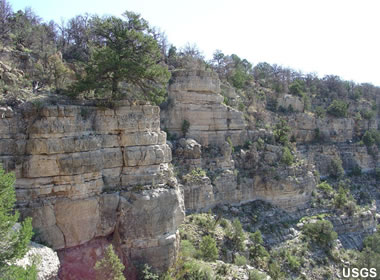
Dolomitic limestone is a rock composed mainly of calcite, but some of that calcite has been altered to dolomite.
Dolomite is thought to form when the calcite (CaCO3) in carbonate sediments or in limestone is modified by magnesium-rich groundwater. The available magnesium facilitates the conversion of calcite into dolomite (CaMg(CO3)2). This chemical change is known as “dolomitization.”
Dolomitization can completely alter a limestone into a dolomite, or it can partially alter the rock to form a “dolomitic limestone.”
Fossiliferous Limestone
Fossiliferous limestone is a limestone that contains obvious and abundant fossils. They are usually marine invertebrates such as brachiopods, crinoids, mollusks, gastropods, and coral. These are the normal shell and skeletal fossils found in many types of limestone.
Fossiliferous limestone often contains information about the environment of deposition, and where the organisms lived (or were deposited). Paleontologists can often examine the fossils and determine the geologic age of the rock.
Lithographic Limestone
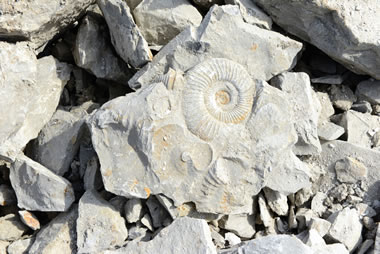
Lithographic limestone is a dense rock with a very fine and very uniform grain size. It occurs in thin beds which separate easily to form a very smooth surface.
In the late 1700s, a printing process known as lithography (named after the stones used) was developed to reproduce images by drawing them on the stone with an oil-based ink, then using that stone to press multiple copies of the image.
Lithographic printing developed into an art form that produced many of the finest maps, navigational charts, posters, and bookplates of the 18th and 19th century. It was used by NOAA and the United States military to produce millions of maps and navigational charts.
Printing with large stones weighing hundreds of pounds to over one ton was cumbersome work. Eventually lithographic printing was done using high-speed presses in which the image was inked on metal rollers and transferred onto sheets or rolls of paper as they streamed through the press.

Oolitic Limestone
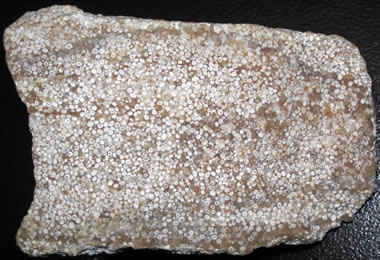
Oolites (or ooliths) are small, sand-size clasts of calcium carbonate with a spherical to ovate shape. They form by the concentric accumulation of calcium carbonate layers around a nucleus that might be a sand grain, a shell fragment, a coral fragment, or a particle of fecal debris. They are thought to form by inorganic precipitation of material around a nucleus while the clast is transported in wave-agitated waters or rolling across sediment surfaces.
In some parts of the Bahamas Platform, oolites are one of the most abundant clasts found in the sediment. In areas where currents from deep water ascend onto the platform, broad areas are covered by great thicknesses of sediment that is almost entirely oolitic.
Oolitic limestone is found in many parts of the world. Oolitic sediment is found in Great Salt Lake, Utah. Some sedimentary rocks are composed almost entirely of ooids and the calcium carbonate cement that binds them together.
Travertine
Travertine is a variety of limestone that forms where geothermally heated alkaline water, supercharged with dissolved gases and minerals, emerges at the surface. There, calcium carbonate and other minerals precipitate as the water degases and begins to evaporate.
Travertine can also form where these waters emerge into subsurface caverns. There, it can precipitate as cave formations such as stalactites, stalagmites, and flowstone.
When pure, travertine is white, but it is often stained by the presence of other minerals to cream, tan, greenish, brownish, and other colors. Because the precipitation is rapid and forms as encrustations on younger materials, travertine is often a banded rock with numerous voids and cavities. It sometimes contains inclusions of organic and mineral debris from the cave or surface environment.
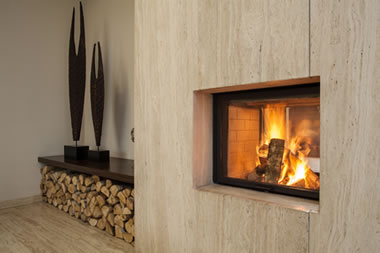
Travertine was mined and used as an architectural stone in ancient Egypt and ancient Rome. Today, Egypt and Italy are famous sources of travertine that is exported throughout the world. It is sawn or sheared into floor tiles, window sills, wall panels, stair treads, and other shapes, mainly for interior use. High-quality material can sometimes accept a polish. The material can be recognized by its low hardness (3 on the Mohs scale), banded appearance, and porous texture.
Tufa
Tufa is a porous limestone produced by precipitation of calcium carbonate from the waters of a hot spring or other body of surface water that has the ability to precipitate volumes of calcium carbonate. The pore space in tufa often results when plant material is trapped in precipitating calcium carbonate.
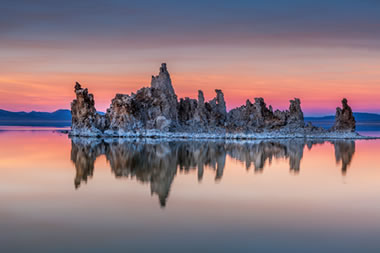
One of the most famous locations where tufa is actively forming is at Mono Lake, Yosemite National Park. The most spectacular tufa features at the lake are known as “tufa towers”. They form by the interaction of freshwater springs and alkaline lake water.
Evaporation around the edges of the lake helps produce the jagged shoreline tufa deposits and a lake that is about 2 1/2 times as salty as the ocean and very alkaline.
In spite of its gnarly appearance as a rock, tufa actually has numerous architectural uses. When found in thick accumulations, tufa can be mined and sawn into blocks and sheets just like any other dimension stone. It produces a stone with a very rugged appearance.