Limestone is a rock with a diversity of uses. It could be the one rock that is used in more ways than any other. Most limestone is made into crushed stone that is used in road base, railroad ballast, foundation stone, drainfields, concrete aggregate, and other construction uses. It is fired in a kiln with crushed shale to make cement.
Some varieties of limestone perform well in these uses because they are strong, dense rocks with few pore spaces. These properties enable them to stand up well to abrasion and freeze-thaw. Although limestone does not perform as well in these uses as some of the harder silicate rocks, it is much easier to mine and does not exert the same level of wear on mining equipment, crushers, screens, and the beds of the vehicles that transport it. In many parts of the world, the harder silicate rocks are too far from construction sites to be used economically.
Some additional but also important uses of limestone include:
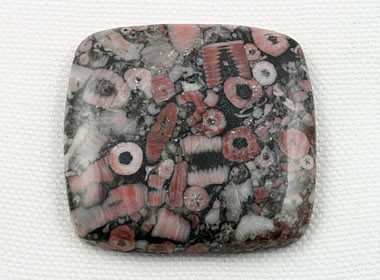
A Gem of Crinoidal Limestone: This cabochon was cut from a piece of fossiliferous limestone that is rich in crinoid debris. Crinoids are organisms that have the morphology of stemmed plants but are actually animals. Rarely, crinoidal and other types of limestone have the ability to accept a bright polish and have interesting colors and patterns. These specimens can be made into unusual and beautiful organic gems. This cabochon is about 39 millimeters square and was cut from material found in China.
Dimension Stone: Limestone is often cut into blocks and slabs of specific dimensions for use in construction and in architecture. It is used for facing stone, floor tiles, stair treads, window sills, and many other purposes.
Roofing Granules: Crushed to a fine particle size, crushed limestone is used as a weather- and heat-resistant coating on asphalt-impregnated shingles and roofing. It is also used as a top coat on built-up roofs.
Flux Stone: Crushed limestone is used in smelting and other metal refining processes. In the heat of smelting, limestone combines with impurities and can be removed from the process as slag.
Portland Cement: Limestone is heated in a kiln with shale, sand, and other materials and ground to a powder that will harden after being mixed with water.
AgLime: Calcium carbonate is one of the most cost-effective acid-neutralizing agents. When crushed to sand-size or smaller particles, limestone becomes an effective material for treating acidic soils. It has been widely used on fields and small plots throughout the world for hundreds of years.
Lime: If calcium carbonate (CaC03) is heated to high temperature in a kiln, the product will be a release of carbon dioxide gas (CO2) into the atmosphere and a residual product of calcium oxide (CaO). The calcium oxide is a powerful acid-neutralization agent. It is widely used as a soil treatment agent (faster acting than aglime) in agriculture and as an acid-neutralization agent by the chemical industry.
Animal Feed Filler: Chickens need calcium carbonate to produce strong eggshells, so calcium carbonate is often offered to them as a dietary supplement in the form of “chicken grits.” It is also added to the feed of some dairy cattle who must replace large amounts of calcium lost when the animal is milked.
Mine Safety Dust: Also known as “rock dust.” Pulverized limestone is a white powder that can be sprayed onto exposed coal surfaces in an underground mine. This bright white coating improves illumination and reduces the amount of coal dust that becomes suspended in the air of the mine. This improves the air for breathing, and it also reduces the explosion hazard produced by particles of flammable coal dust suspended in the air.
Limestone has many other uses. Powdered limestone is used as a filler in paper, paint, rubber, and plastics. Crushed limestone is used as a filter stone in on-site sewage disposal systems. Powdered limestone is also used as a sorbent (a substance that absorbs pollutants) at many coal-burning facilities.
Limestone is not found everywhere. It only occurs in areas underlain by sedimentary rocks. When limestone is needed in other areas, buyers sometimes pay five times the mine-site cost of the stone in delivery charges so that limestone can be used in their project or process.
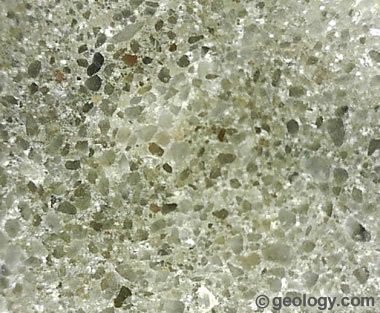
Anti-Skid Aggregate: This image is a microscopic view of a polished surface of the Loyalhanna Limestone from Fayette County, Pennsylvania. The Loyalhanna is a Late Mississippian calcareous sandstone to arenaceous limestone, composed of siliceous sand grains embedded in and bound by a matrix of calcium carbonate. In outcrop, the Loyalhanna is cross-bedded with features that have caused geologists to argue if it is of marine bar or eolian dune origin. This view shows about one centimeter of rock between opposing corners of the photo with sand grains measuring about 1/2 millimeter in diameter. As a construction material, the Loyalhanna is valued as an anti-skid aggregate (crushed stone). When it is used to make concrete paving, sand grains in aggregate particles exposed on a wet pavement surface provide traction for tires, giving the pavement an anti-skid quality.