Pure rock salt under bright illumination will range in color between colorless and white. Colorless salt is usually the most pure because the most common cause of color is impurities. White salt often contains minute gas-filled or fluid-filled cavities.
Specimens or zones of other colors can be caused by mineral grains included in the salt, trace elements in the salt, or small defects in the salt’s crystal structure – such as a missing electron. The remains of microscopic organisms in the salt can also produce color.
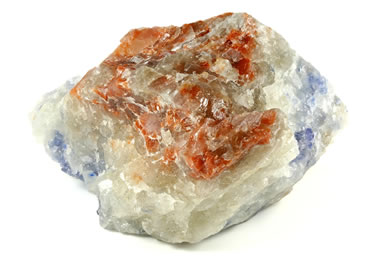
Most specimens of raw rock salt contain minute to clearly visible inclusions. These can be clastic sediment particles, such as clay minerals; crystals of secondary minerals, such as sylvite; or, patches of solid or liquid hydrocarbons. Crystals or massive inclusions of other evaporite minerals, such as gypsum, anhydrite, or sylvite are common.
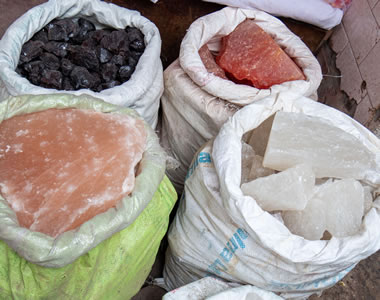
Reflection of light by any included material can impart an apparent color to the salt. Absorption of light by included materials can produce an apparent gray or black color. Trace elements or defects in the salt’s crystal structure, known as color centers, sometimes produce color in the salt.