Rock salt has many uses. The most important uses in the United States are described below.
Highway Deicing
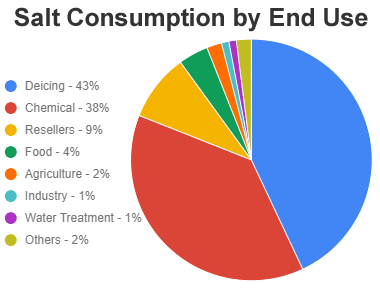
The leading use of rock salt in the United States is highway deicing. In calendar year 2020, an estimated 43% of rock salt consumption was used for this purpose. The amount of highway salt consumed varies significantly from year to year, depending upon weather conditions. Variations in the need for highway salt are responsible for most of the year-to-year variation in national consumption.

The rock salt is mined, crushed to appropriate size, and usually applied to roads and highways without further processing. When applied dry, much of the salt can bounce off of the road or be scattered by the wind of passing traffic. If the salt is applied wet, more of it sticks to the road, and the loss of salt is reduced.
Use of rock salt as a road and highway deicer has some environmental problems. Two are related to salt dissolved in water entering the ground on the roadside. The salty water can kill roadside vegetation. It can also contaminate shallow groundwater that might be withdrawn from personal or private water supply wells. It might also discharge into local streams where it can kill or sicken plants, fish, and animals.
Chemical Industry Feedstock
The second most important use of salt in the United States is as a feedstock for the chemical industry. In 2020, about 38% of the country’s salt consumption was used to produce chlorine, sodium hydroxide, synthetic soda ash, and other chemicals. The chemicals were then used as ingredients in plastics, paints, solvents, and a variety of household and industrial cleaning products.
Instead of producing their salt by traditional mining methods, the chemical industry obtains much of their salt by solution mining. They drill wells down into a subsurface salt layer and pump water down some of the wells. That water dissolves some of the salt and is withdrawn up other wells as a concentrated salt solution.
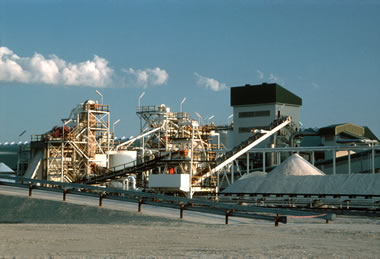
That salt solution, known as brine, is rich in sodium and chlorine and is used in chemical manufacturing. The map at the top of this page shows the geographic extent of the most important parts of the United States’ subsurface salt resource.
Retail and Wholesale Sales
Bags of rock salt are sold by wholesale and retail stores in many countries where the climate can cause snow and ice problems on roads, sidewalks, driveways, and parking areas. Homeowners and businesses buy much of this salt.
In 2020 about 9% of the rock salt consumed in the United States was sold in retail and wholesale transactions. Much was also sold in bulk and used for pavement deicing by local snow removal companies and local governments. This salt was also sold for a diversity of other uses.

Food Processing
Almost every person in the United States consumes some salt in every meal. Even if they do not use a salt shaker – the salt was probably added when the food was processed. In 2020, about 4% of the salt consumed in the United States was used by the food processing industry and seasoning makers.
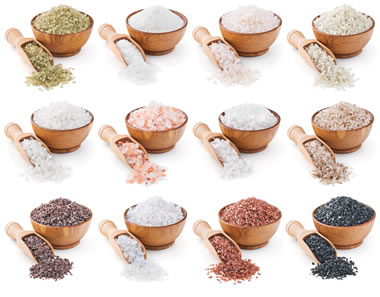
Salt is used in food to enhance flavor, to enhance color, as a preservative, to enhance texture, to control fermentation, to tenderize, and for other reasons. Pets need salt as an essential nutrient, and a significant amount of salt is used to make pet foods.
Agricultural Salt
Salt is an essential nutrient of farm animals. In 2020 about 2% of the United States’ salt consumption was sold to the agricultural industry. Salt is used in preparing some animal feeds, as a water conditioner, and as salt blocks.
Salt blocks are 50-pound cubes of salt that are placed in animal feeding or grazing areas. The animals instinctively lick them to satisfy their need for salt. Many salt blocks have added iodine, sulfur, trace elements, and vitamins to make up for nutrients that might not be received by the animal in their grazing and feed.

Water Treatment
Salt is used in commercial and residential water-conditioning units to treat hard water – a problem that occurs when water contains an excessive amount of calcium and magnesium ions. Hard water can cause a build-up of mineral deposits in pipes, equipment, and appliances. It can also reduce the effectiveness of soap and other cleaning supplies.
Water conditioning systems expose the water to sodium ions obtained from the salt. The sodium ions are exchanged for the calcium and magnesium ions in the water to reduce hardness. The salt supply in these water conditioning systems must periodically be replenished.