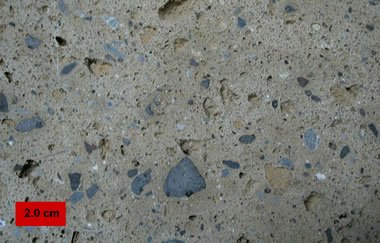
“Tuff” is a name that is used for a broad range of materials. The only requirement is that the materials are ejecta produced by a volcanic eruption. Tuff can contain fragments of dust-size particles to boulder-size particles and be composed of many different types of material.
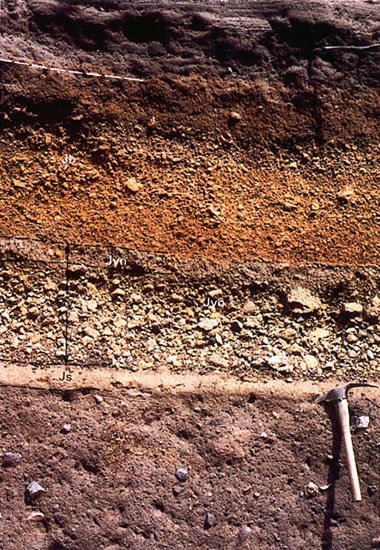
Mount St. Helens tephra: Photograph of an outcrop of stratified tuff that formed from tephra produced by pre-1980 eruptions at Mount St. Helens, Washington. This photograph shows several layers of tephra with different textures and different compositions, each from a different eruptive event.
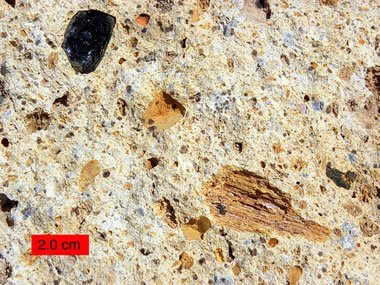
Many tuff deposits contain fragments of bedrock that are unrelated to volcanic activity. These materials are involved when the volcanic explosion occurs below the ground. The subsurface explosion crushes the overlying bedrock and launches it into the air mixed with tephra and volcanic ash produced from the magma source below.
Different volcanoes are supplied with magma of different compositions. Many tuff deposits form from magma with a rhyolitic composition, but andesitic, basaltic, and other types of magma might contribute to the tuff.
Tuff also varies by particle size. Near the vent, a tuff might consist mainly of large blocks of material in a volcanic ash matrix. With distance from the vent, the clasts will be smaller in size. At the edges of the rock unit, the tuff might be mainly composed of very fine ash.