The grains of sand in a sandstone are usually particles of mineral, rock, or organic material that have been reduced to “sand” size by weathering and transported to their depositional site by the action of moving water, wind, or ice. Their time and distance of transport may be brief or significant, and during that journey the grains are acted upon by chemical and physical weathering.
If the sand is deposited close to its source rock, it will resemble the source rock in composition. However, the more time and distance that separate the source rock from the sand deposit, the greater its composition will change during transport. Grains that are composed of easily weathered materials will be modified, and grains that are physically weak will be reduced in size or destroyed.
If a granite outcrop is the source of the sand, the original material might be composed of grains of hornblende, biotite, orthoclase, and quartz. Of these minerals, hornblende and biotite are the most chemically and physically susceptible to destruction, and they would be eliminated in the early stage of transport.
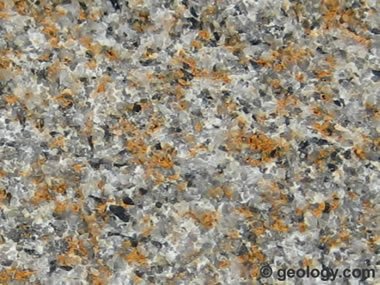
Orthoclase and quartz would persist longer, but the grains of quartz would have the greatest chance of survival. They are more chemically inert, harder, and not prone to cleavage. Quartz is often the most abundant type of sand grain present in sandstone. It is abundant in source materials and is the most durable during transport.