Hydraulic properties are characteristics of a rock such as permeability and porosity that reflect its ability to hold and transmit fluids such as water, oil, or natural gas.
Shale has a very small particle size, so the interstitial spaces are very small. In fact they are so small that oil, natural gas, and water have difficulty moving through the rock. Shale can therefore serve as a cap rock for oil and natural gas traps, and it also is an aquiclude that blocks or limits the flow of groundwater.
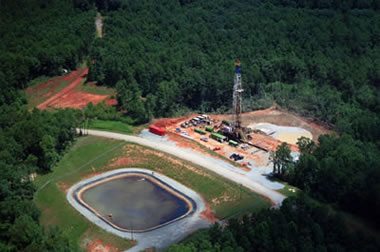
Although the interstitial spaces in a shale are very small, they can take up a significant volume of the rock. This allows the shale to hold significant amounts of water, gas, or oil but not be able to effectively transmit them because of the low permeability. The oil and gas industry overcomes these limitations of shale by using horizontal drilling and hydraulic fracturing to create artificial porosity and permeability within the rock.
Some of the clay minerals that occur in shale have the ability to absorb or adsorb large amounts of water, natural gas, ions, or other substances. This property of shale can enable it to selectively and tenaciously hold or freely release fluids or ions.