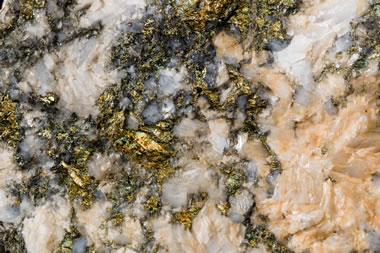
Chalcopyrite and small pieces of biotite or phlogopite mica can fool you. Chalcopyrite (a copper iron sulfide) has very similar properties to pyrite. It has a lower hardness than pyrite (3.5 to 4) and a lower specific gravity than pyrite (4.1 to 4.3), but the same tests can separate chalcopyrite from gold. Chalcopyrite also has a greenish black streak.
Pyrrhotite is an iron sulfide mineral with a chemical composition of Fe(x-1)S. It has a high specific gravity, often has a brassy color, and a distinctly metallic luster. It is easy to separate pyrite and pyrrhotite because pyrrhotite is magnetic, is much softer, and if you can see crystals they will be a very different shape.
Many people are surprised that flakes of biotite or phlogopite mica can fool people into thinking that they are gold. This most often occurs when an inexperienced person is panning for gold and sees a bright flash in their gold pan. After chasing the tiny, highly lustrous flake, they think that it might be gold. However, slight pressure with a pin can break the flake of mica, but a tiny flake of gold will bend around the pin.