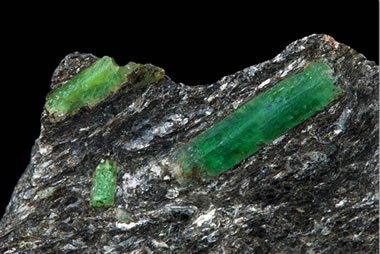
Emerald is the deep green color variety of the mineral known as beryl. To be an emerald, a beryl must have a rich green color that ranges between bluish green, green, and slightly yellowish green. Pale green specimens and those outside of the required color range should be called “green beryl.”
Today, emerald, together with ruby and sapphire, generate more economic activity than all of the other colored gemstones combined. In many years, the dollar value of emeralds imported into the United States exceeds the value of ruby and sapphire combined.
Emerald is only found in a few locations worldwide. It is found only in those rocks where enough beryllium to produce beryl was present at the same time that chromium or vanadium were present to give the gem its color. As a result, most of the world’s emeralds are mined in just four countries: Colombia, Zambia, Brazil, and Zimbabwe. In the United States, a few occurrences of emerald have been found in North Carolina.
Emerald is rare, it has a very high price, and natural emeralds are usually marked with fractures and abundant inclusions. In response, laboratory-created emeralds are now more abundant in mall and department store jewelry displays than natural stones. Consumers enjoy their visually perfect clarity and exceptional color, along with a price that is a fraction of what would be paid for natural stones of similar color, size, and clarity. They have the same chemical, physical, and optical characteristics as natural emeralds.