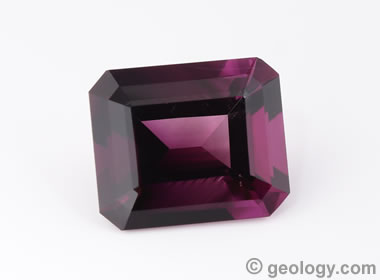
Small amounts of amethyst are found at many locations throughout the world in igneous, metamorphic, and sedimentary rocks. Faceting, cabbing and ornamental grade amethyst can be found in all of these locations; however, the amount is usually insufficient to support an ongoing mining operation.
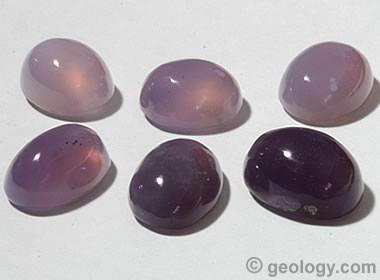
Why are those names improper? They are improper because purple quartz (amethyst) and chalcedony are two different gemological materials. The name chalcedony is used for microcrystalline quartz — quartz that is in crystals so small that they cannot be seen without the aid of a microscope.
Fortunately, it is easy to tell the difference between quartz and chalcedony. Quartz has a vitreous luster on conchoidal fracture faces, while chalcedony has a dull luster on conchoidal fracture faces.
If you use a hand lens or a microscope to examine the facet junctions on a faceted stone or the boundary between the flat base of a cabochon and its domed sides, you can usually find at least one tiny conchoidal fracture. There is where you can observe the luster. These materials also have a difference in refractive index.
Purple chalcedony and lilac chalcedony, are acceptable names for this material. The name “amethyst” is an incorrect varietal name when used as an adjective for chalcedony.
The world’s most important amethyst deposits are usually found in the fractures and cavities of igneous rocks. In Brazil and Uruguay large amounts of amethyst are found in the cavities of basalt flows. Large cavities can contain hundreds of pounds to several tons of amethyst crystals.
Smaller cavities, known as geodes, are often opened in a way that displays the crystals inside and then fitted with a base that allows them to be used as home or office decor. They are popular sales items at rock shops and mineral shows.
Other productive amethyst deposits are located in Canada, France, India, Madagascar, Mexico, Morocco, Myanmar, Namibia, Russia, South Africa, Sri Lanka, Tanzania, and the United States.
Amethyst has been produced at many locations in the United States. Much of it has been as a byproduct of other mining operations. Today, the only commercially run amethyst mine in the United States is the Four Peaks Mine in Arizona. The mine is well known for producing amethyst with a reddish purple color. The deposit was also known by Native Americans because a few amethyst arrowheads have been found nearby. Some of the amethyst in the Spanish crown jewels may be from this deposit, brought back to Spain by Spanish explorers.