The mean refractive index of benitoite is greater than that of sapphire, and measures 1.757 to 1.804 (sapphire 1.759 to 1.767). The birefringence is high and the pleochroism very strong. The crystals are generally transparent with a pale to deep-blue and bluish-violet color. Color variations are common in the same crystal, and the change from dark to light blue or colorless may be sharp or gradual. The pleochroism of benitoite is pale to dark-blue or purplish and colorless. The richest colors are seen when the crystals are viewed parallel to the base. The intensity of the blue diminishes as the light ray penetrates the crystal at other angles until perpendicular to the base, when the crystal is colorless. Care is necessary, therefore, in cutting the gem so as to secure the best effects. Pale-colored stones should be cut with the table perpendicular to the base or parallel to the vertical axis of the crystal to secure the full color value. Deeper colored stones may be cut in the same way or with the table in an intermediate position, if the color is very strong. By cutting intensely colored stones with the table only slightly out of parallel to the base, the color may be reduced to a desirable shade. The dichroscope may be used to determine the position of the vertical axis and accordingly of the base perpendicular to it. When viewed perpendicular to the vertical axis with a dichroscope the twin colors or two rays of light are very intense to pale blue (depending on the depth of color of the crystal) and colorless. When viewed parallel to the vertical axis, or perpendicular to the base, the two rays are colorless and remain so while the dichroscope is rotated. The color of one of the rays becomes stronger as the crystal is rotated from this position. Benitoite crystals exhibiting two shades of color, as dark and light blue or blue and colorless in different parts of the same crystal, may be cut so as to show these variations, or sometimes in such, a way that the resulting color is of nearly uniform intensity.
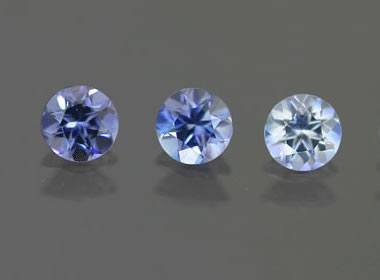
Benitoite has been cut as a brilliant, with the step or trap cut, and “en cabochon.” The brilliant cut is especially suitable to show the brilliancy and fire of the gem. The brilliancy is due to the high refractive index and the fire or red flash, often seen in dull or artificial light is, in part at least, caused by the dispersion of the mineral. Of the colors produced by dispersion during the refraction of light in benitoite yellow and green are largely absorbed in the colored gems so that principally red and violet-colored lights are seen. These flashes of colored lights along with the natural fine blue of benitoite render the gem particularly beautiful. The step cut displays the color of benitoite to advantage, with only slight loss of brilliancy. Cabochon-cut gems from crystals with color variations or partially flawed material have some beauty.
The size of the gems cut from benitoite range in weight from a small fraction of a carat to several carats. According to Doctor Louderback the largest perfect stone so far cut weighs over 7 carats and is about three times as heavy as the next largest flawless gem so far obtained. The majority of larger cut stones weigh from 1 1/2 to 2 carats.
The principal production is in stones weighing less than 1 1/2 carats. The use of benitoite in rings or jewelry subjected to hard wear is limited by its comparative softness. The beautiful color, brilliancy, and fire of the gem, however, adapt it to other classes of fine jewelry. Since the supply of benitoite is thought to be limited and a fairly large demand has already arisen for the gem, it is probable the price will be kept high, possibly as high as that of sapphire, its nearest rival in color.