Beryl, the mineral of which emerald is a variety, has a chemical composition of Be3Al2(SiO3)6. When pure, beryl is colorless and known as “goshenite.” Trace amounts of chromium or vanadium in the mineral cause it to develop a green color. Trace amounts of iron will tint emerald a bluish green or a yellowish green color depending upon its oxidation state.
Emerald is defined by its green color. To be an emerald, a specimen must have a distinctly green color that falls in the range from bluish green to green to slightly yellowish green. To be an emerald, the specimen must also have a rich color. Stones with weak saturation or light tone should be called “green beryl.” If the beryl’s color is greenish blue then it is an “aquamarine.” If it is greenish yellow it is “heliodor.”
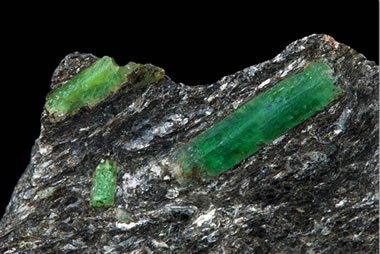
This color definition is a source of confusion. Which hue, tone, and saturation combinations are the dividing lines between “green beryl” and “emerald”? Professionals in the gem and jewelry trade can disagree on where the lines should be drawn. Some believe that the name “emerald” should be used when chromium is the cause of the green color, and that stones colored by vanadium should be called “green beryl.”
Calling a gem an “emerald” instead of a “green beryl” can have a significant impact upon its price and marketability. This “color confusion” exists within the United States. In some other countries, any beryl with a green color – no matter how faint – is called an “emerald.”
Be careful if you are buying an “emerald”. Make sure that you are getting a gem that has a rich green color instead of a “green beryl”. Buying from a website where people from outside of the United States are acting as third-party sellers and photographs might not have representative color can be especially risky.
| Physical Properties of Emerald | |
| Color | A distinctly green color that ranges between bluish green and slightly yellowish green. Stones with a light tone or a low saturation should be called “green beryl” instead of emerald. |
| Clarity | Almost every natural emerald has eye-visible characteristics that can be inclusions, surface-reaching fractures, or healed fractures. Treatments to fill the fractures with oils, waxes, polymers, flux and other materials to reduce their visibility has been common practice for hundreds of years. |
| Luster | Vitreous |
| Diaphaneity | Transparent to translucent |
| Cleavage | One direction of imperfect cleavage |
| Durability | Emerald is very hard, but almost all specimens have inclusions and surface-reaching fractures that compromise their durability. |
| Mohs Hardness | 7.5 to 8 |
| Specific Gravity | 2.7 to 2.8 |
| Chemical Composition | Be3Al2(SiO3)6 Emerald’s green color is caused by trace amounts of chromium or vanadium. |
| Crystal System | Hexagonal. Often as prismatic crystals. |