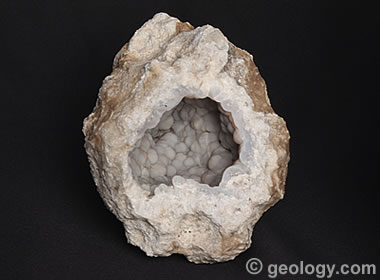
Everyone expects to find bright, shiny, geometric crystals when they open a geode. But, sometimes there are other interesting landscapes inside. One of the most common finds when geometric crystals are not present is a geode lined with chalcedony, a microcrystalline variety of quartz.
Chalcedony crystals as so small that they cannot be seen with the unaided eye. In a geode, a tiny crystal of chalcedony will attach to the wall and it will be coated with a layer of tiny chalcedony crystals all pointing outwards from the seed crystal. Layer after layer is deposited, and the early result looks like a small hemisphere attached to the inner surface of the geode. These tiny hemispheres begin to grow into and over one another, and the result is a landscape that looks like a pile of grapes. This hemispherical geometry is a common crystal habit of chalcedony known as botryoidal. An example of a geode lined with botryoidal chalcedony is shown in the accompanying photo.