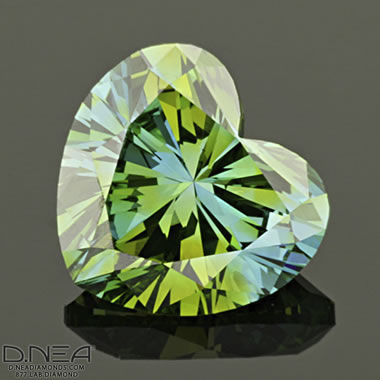
A) Formation of Natural-Color Green Diamonds
Diamonds with a natural green color developed that color while they were underground, in rocks that contained small amounts of radioactive material such as uranium or thorium. As the radioactive materials decayed, they emitted radiation that penetrated the nearby diamond crystal. When this type of radiation enters a diamond, it can knock electrons or carbon atoms out of their position in the crystal lattice. This alteration most strongly influences the outer layer of the diamond crystal. As a result the green color is often present as a shallow “skin” on the outside of the diamond crystal. Diamonds with a uniform green color throughout the stone are exceptionally rare.
The displacement of electrons and carbon atoms deforms the crystal lattice and changes the way light travels through the diamond. The deformation causes the diamond crystal to selectively absorb much of the light entering the diamond and selectively transmit wavelengths in the green portion of the spectrum. This green light travels to the eye of the observer and gives the diamond a green appearance.
Green color from natural irradiation is the most common cause of green color in diamonds. However, green color can also be caused by structural defects in the diamond’s crystal structure, caused by the presence of nitrogen, hydrogen or nickel atoms.
B) Treated Green Diamonds
Ingenious people are always trying improve the color of gemstones to increase their value. They do this by mimicking the processes of nature or applying treatments that alter the color of the gem.
The first documented treatment to produce green diamonds was an experiment done by Antoine-Henri Becquerel, shortly after his discovery of radioactivity in 1896. He irradiated some diamonds to see if they would be altered, and their color changed to green.
In 1904, Sir William Crookes stored a few polished diamonds in radioactive salts. When they were removed from the salt, the diamonds had a green color at the surface and that color extended to a shallow depth. This method of diamond treatment is not used today because the diamonds can be contaminated with radioactivity that does not decay to safe levels within a reasonable period of time.
The most common laboratory treatment used today to produce a green color in diamonds is irradiation of polished diamonds with a low-energy electron beam. This treatment has been used since the late 1940s, and it can modify near-colorless or yellow diamonds to produce diamonds with a green color.
Another treatment to produce green diamonds today is to apply a thin coating of silica to the surface of the polished gems. The coating can produce an attractive appearance, but it is very thin and can eventually be worn off by the abrasion of normal wear.
Diamonds that owe their green color to a treatment should always be sold with a disclosure that the color was produced by treatment, and state the method of treatment. Because so many buyers prefer diamonds with a natural color, green diamonds colored by treatment generally sell for a significantly lower price than natural green diamonds of similar color, size and quality.
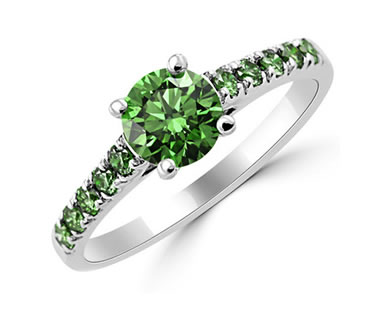
C) Green Synthetic Diamonds
Synthetic diamond crystals have been successfully grown in laboratories in a variety of colors. Synthetic diamonds with a light green color and a greenish yellow color have been produced when small amounts of nitrogen and boron were incorporated into the diamond.
Green synthetic diamonds have also been produced by irradiating colorless or yellow synthetic diamonds. So, there can be green synthetic diamonds with an “as grown” green color, and green synthetic diamonds that obtained their green color from “post-growth treatments.”