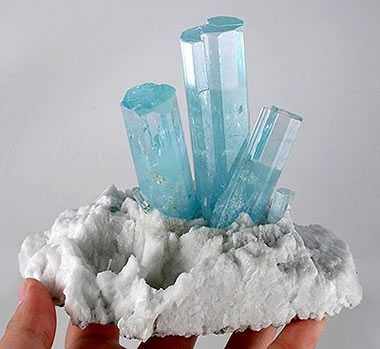
Most gem-quality aquamarine crystals form in cavities below Earth’s surface during the late stages of a magma body’s crystallization. The cavities provide open space for crystals to grow. The slow underground cooling rate provides the time needed for the development of large crystals. And, the late-stage timing provides the fluids and a supply of the beryllium needed to form beryl, a beryllium mineral.
Aquamarine is usually found in granite pegmatites. Another source is from veins in metamorphic rocks that were mineralized by hydrothermal activity.
If rocks containing aquamarine are exposed by weathering and erosion, the exceptional hardness of aquamarine (7.5 to 8 on the Mohs scale) will cause it to persist in overlying soils and stream sediments. Much aquamarine has been produced from stream sediments. Where it is found in stream sediments suggests that a primary deposit is located upstream.