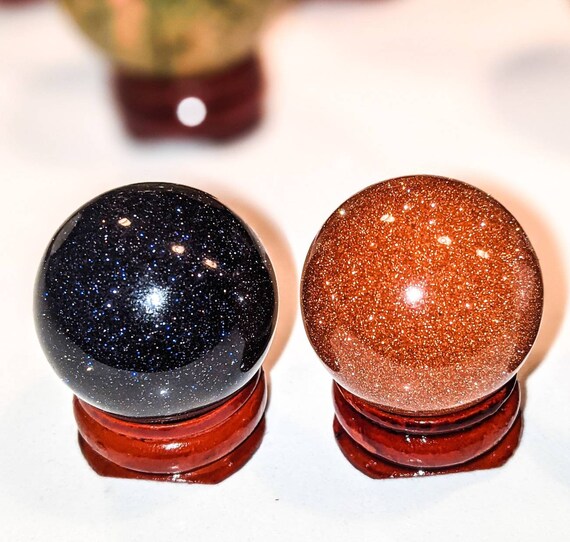
The glittery appearance of goldstone is often attributed to “bits of copper” or “copper filings” that have been added to the glass. That simplistic description is incorrect.
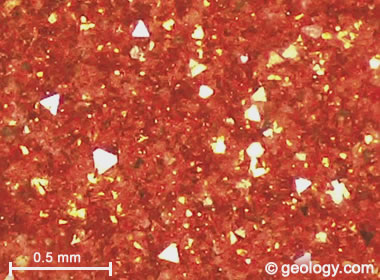
Reddish brown goldstone is made by heating molten glass to a temperature that is hot enough to dissolve granules of copper oxide that are added to the melt. After the copper oxide is completely dissolved, the melt is allowed to cool very slowly. This slow cooling gives copper ions in the melt adequate time find one another and grow into octahedral-shaped copper crystals. The slower the cooling, the larger the copper crystals.
The bright metallic luster of these copper crystals is what produces the sparkling appearance of goldstone. An octahedral crystal has eight triangular faces. If you look at goldstone with a microscope under reflected light, you will see triangular faces of the copper crystals reflecting the light back at you from various depths below the surface of the glass.
The glass of reddish brown goldstone is colorless. Its reddish brown appearance is caused by reflections from the included copper crystals. Blue, green, and purple goldstone are made using compounds of metals other than copper. The color of these goldstones is caused by the color of the glass rather than the color of the reflections from the metallic crystals. The glass color of blue goldstone is caused by cobalt, green is caused by chromium, and purple is caused by manganese.
Reflections from the metallic crystals within the goldstone attract attention and give goldstone its sparkling appeal. The sparkling appearance of the reflections is intensified in three situations: when the goldstone is moved under incident light; when the light source is moved; and, when the eye of the observer is moved.