Jadeite and nephrite are minerals that form through metamorphism. They are mostly found in metamorphic rocks associated with subduction zones. This places most jadeite and nephrite deposits along the margins of current or geologically ancient convergent plate boundaries involving oceanic lithosphere.
Jadeite is typically found in rocks that have a higher pressure origin than nephrite. This normally causes a geographic separation of jadeite and nephrite deposits.
From ancient times, much of the prospecting for jade has been done in the steeper parts of drainage basins, where pebble- to boulder-size pieces of rocks are found in stream valleys. Boulders and pebbles of jade normally have a brown weathering rind that hides their inner beauty and potential value.
Prospectors search these valleys looking for jade boulders. Small windows are often cut into the boulders in the field to assess the material’s quality and to determine if it is worth the labor of transport.
Jade boulders can be very difficult to transport without damage. Human and animal labor was the only way to transport them historically. Today in some areas that is still the only way to move the boulders to market. Where economics allow, a helicopter with a basket or sling on a cable will fly in to difficult areas. Workers on the ground will prepare the boulders for lifting, and the helicopter will fly them out. Although helicopters are very expensive to use for this type of work, one nice boulder can be worth many thousands of dollars or more in rough form.
Some jade is also mined from hard rock deposits. Boulders are sometimes mined from ancient conglomerates, but ophiolite exposures are the most important type of hard rock deposit. Ophiolites are the metamorphosed rocks of ancient subduction zones, now exposed at the surface by faulting or uplift, followed by exhumation by weathering. Jade is mined from ophiolites by both surface and underground methods.
Geographically, much of the world’s jade is found around the rim of the Pacific Ocean, where subduction transports large slabs of oceanic lithosphere beneath continents and volcanic island arcs. This accounts for much of the jade found in South America, Central America, the United States, Canada, eastern Asia, and New Zealand.
Perhaps the most attractive and valuable jade found in the United States is from the area around Jeffrey City and Crooks Gap in Wyoming. There, nephrite jade is found by prospecting alluvial sediments, looking for jade in stream-rounded pebble- to boulder-size pieces.
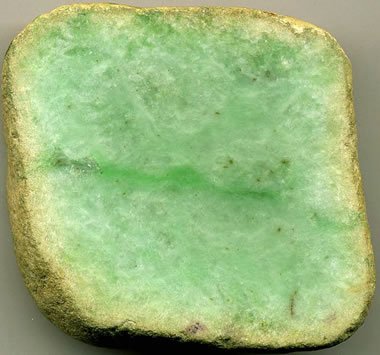
Green Jadeite Boulder: An alluvial boulder of green jadeite with a brown weathering rind from northern Burma. This boulder is about 6 centimeters across.