Contrary to some marketing messages, lab-grown diamonds and natural diamonds are not identical in every way. Lab-grown diamonds are produced at Earth’s surface by two different processes: HPHT (high pressure high temperature) and CVD (chemical vapor deposition).
Diamond crystals grown in these manufacturing processes inherit characteristics of the manufacturing process that can be used to tell them apart. These characteristics can also be used to separate them from natural diamonds.
The most obvious difference is the shape of the diamond crystals immediately after growth. Diamond crystals grown by the HPHT process normally exhibit cubic and octahedral faces. On the other hand, diamond crystals grown by the CVD process are normally tablular to blocky in shape and have a coating of graphite on four sides.
Some lab-grown diamonds that have been faceted can be separated from natural diamonds by a trained gemologist using standard tools. Using a gemological microscope, the gemologist can sometimes identify inclusions or other features that are unique to HPHT-grown diamonds, CVD diamonds or natural diamonds. HPHT-grown diamond often contains inclusions of the molten metal flux in which the diamond is grown. CVD-grown diamonds often contain tiny dark pinpoint inclusions. Inclusions in HPHT and CVD diamonds were common during the early days of lab-grown diamonds, however, many diamond manufacturers have improved their methods to minimize these inclusions.
A microscope that enables observations under ultraviolet illumination can reveal fluorescent color and crystal growth patterns that are unique to HPHT and CVD production. But, most gemologists do not have this equipment. Even if the gemologist had that equipment, and the necessary training, many diamonds would not be identified with certainty. Thus, more sophisticated tools are needed.
Fortunately, several companies have invented portable screening devices that can separate natural diamonds from lab-grown diamonds. These devices correctly identify about 98% of natural diamonds and refer all other stones (lab-created diamonds, imitation materials, and the remaining 2% of natural diamonds) for additional testing. The cost of these screening devices starts at about $4000. More sophisticated devices that successfully separate natural, lab-grown, and imitation stones from one another can be purchased, but the cost for these starts at about $20,000, which is quite costly for many small businesses. But, to buy and sell with confidence, a business must invest in the knowledge of its staff and obtain the necessary equipment. Otherwise the business leaves itself open to errors and dishonesty in the supply chain.
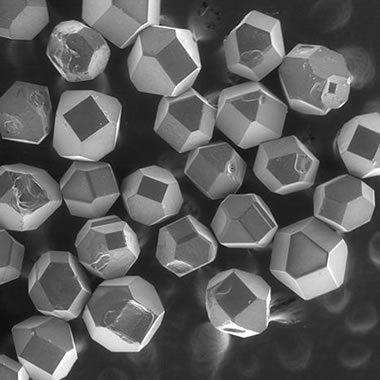
Synthetic HPHT Diamonds grown in the High-Temperature Materials Laboratory of the Moscow Steel and Alloys Institute. They can be identified as HPHT diamonds because they exhibit both cubic and octahedral crystal faces.
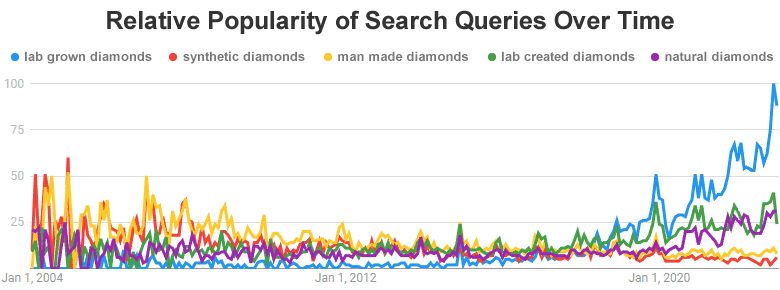
Google Trends: The image above is a screenshot from Google Trends, an online tool used to display changes in the number of people who type specific queries into Google. It can also track the relative number of people querying Google for a variety of terms. The chart above shows the relative number of people searching Google for five different queries: lab grown diamonds, synthetic diamonds, man made diamonds, lab created diamonds and natural diamonds. At the time this Google Trends chart was created (January 2023), the query “lab grown diamonds” had recently exploded from the least frequently searched into the most frequently searched of these five queries. The author believes that this surge in the use of the term “lab grown diamond” was produced by the initial, and sustained, advertising used by De Beers in the launch of their Lightbox Jewelry project. It is possible that De Beers has made a long-term mark on search query language.