The big diamond rushes in Africa occurred in the late 1800s, and information about the deposits there was widely published. Prior to Huddlestone’s discovery, geologists at the Arkansas State Geological Survey suspected that diamonds might occur in the greenish peridotite soils near Murfreesboro because they were similar to the soils above the African diamond deposits. They did fieldwork in the area but did not find any diamonds.
The general public also knew about the diamond rushes in Africa, and this fueled excitement about Huddlestone’s discovery. One of the large diamond discoveries in Africa was also made on a family farm. The owners of the farm sold out because they could not protect their land from the hordes of diamond hunters. The farmers’ name continues today as the name for one of the largest diamond mining companies in the world – De Beers.
John Huddlestone sold his farm for $36,000 and it was later bought and sold multiple times. It was temporarily worked as a commercial diamond mine. It was not extremely productive and was not reopened after a fire destroyed the plant in 1919. Properties adjacent to the Huddlestone farm were also heavily prospected with some attempts at diamond production, none of which were sustained.
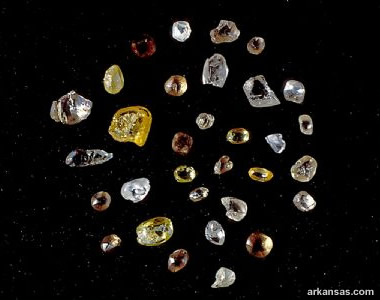
Arkansas diamonds: All of these diamonds were found at the Crater of Diamonds. Most of the diamonds found at the Park are in a color range from white to yellow through brown.