The mineral zoisite naturally occurs in a wide range of colors that include colorless, gray, yellow, brown, pink, green, blue, and violet. The name “tanzanite” is used for a color variety of zoisite that ranges from blue, through violet, to violetish purple.
This type of color-variety name is not unusual. The name “ruby” is used for red to slightly purplish red specimens of the mineral corundum; the name “amethyst” is used for purple specimens of the mineral quartz; and, the name “emerald” is used for green specimens of the mineral beryl. Each of these minerals occurs in a wide range of other colors.
The discovery of transparent crystals of blue zoisite in the 1960s stimulated interest in the gem. Soon after that discovery, laboratory experiments determined that heating could improve the color of some naturally blue stones.
They also determined that heating could convert some naturally brown or green zoisite into beautiful blue zoisite (tanzanite!). With those discoveries, there would be enough tanzanite to support a marketing effort that would introduce the gem to millions of people.
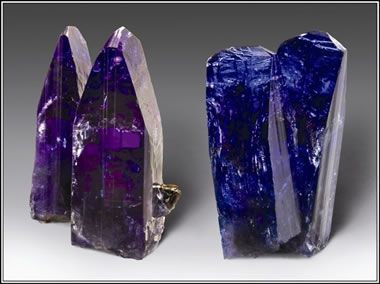
Natural blue tanzanite: The pair of crystals shown on the left is the same pair of crystals shown on the right. They have different apparent colors because tanzanite is pleochroic – it appears to be different colors when viewed from different directions.
If we cut a faceted stone from the crystal pair on the right and oriented the cutting so that, in this view, we were looking down onto the top of the table, the stone would have a blue face-up color. If we did the same with the crystal pair on the left, the stone would have a purple face-up color. If the table of the stone were tilted slightly in any direction, an intermediate face-up color would be produced.
This pair of crystals has not been heated by humans. Their colors are natural. It is an example of tanzanite having spectacular natural color.