Rose quartz is one of the most commonly encountered lapidary materials. It is abundant, usually inexpensive, and popular as tumbled stones, beads, and cabochons. These have the richest color when pieces are at least a centimeter in diameter or thickness because of the material’s weak color. With a hardness of 7 on the Mohs scale and a lack of cleavage, rose quartz is durable enough for use in any type of jewelry.
Faceted rose quartz is rarely seen because transparent pink quartz is rare, and translucent rose quartz does not compete well with other faceted materials. Although rose quartz cabochons are popular in craft jewelry, rose quartz is seen far less often in commercial or designer jewelry. Its pink color does not contrast strongly with metal settings or the skin color of many people. Faceted gems such as pink sapphire, morganite, rhodolite, spinel, and tourmaline are used instead of pink quartz, probably because of their superior clarity and brighter luster.
Pieces of rose quartz up to a few pounds in size with nice color are usually available and relatively inexpensive. For that reason it is commonly used to produce small sculptures, puffed hearts, spheres, and utility items.
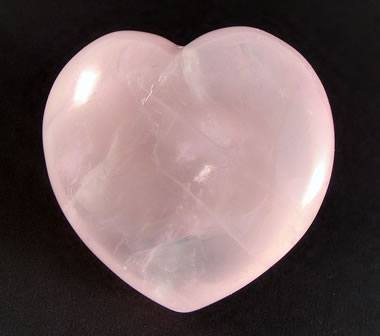
Rose Quartz Heart: A favorite lapidary project is making puffed hearts from rose quartz. They are made by starting with a thick slab of rose quartz and cutting it in the outline of a heart. It is then domed, like a cabochon, on both sides. This gives it a three dimensional shape known as a “puffed heart”. They are an easy project for lapidarists with minimal experience and popular as pendants, palm stones and tokens.
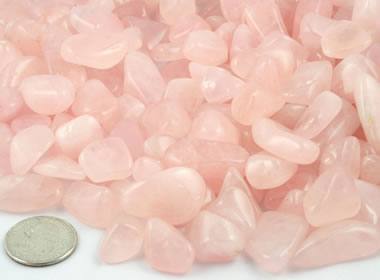
Tumble-Polished Rose Quartz: Tumbled stones made from rose quartz mined in Namibia. Rose quartz is one of the most popular tumbled stones because of its attractive pink color.