While azurite is not an extremely abundant mineral and is rarely found in large deposits, it has been used in a number of ways. Some of these are explained below.
Copper Prospecting and Mining
Geologists know that abundant azurite is often found in the rocks above deposits of copper ore. That enables them to use azurite as an indicator mineral in the search for subsurface copper deposits. The presence of abundant azurite indicates the possibility of finding some form of copper ore below, nearby, or up a contemporary or ancient hydraulic gradient.
Azurite has been used as an ore of copper metal for thousands of years. The ancient Egyptians mined it on the Sinai Peninsula and smelted it to produce copper. Today, azurite deposits on their own are usually not large enough to be worth opening a copper mine. Where other copper ores are mined, azurite might be removed if it is of adequate grade and easy to mine.
Jewelry and Ornamental Stone
Azurite is easy to cut and shape into cabochons, beads, small carvings, and ornaments. It also accepts a bright polish. Unfortunately, azurite has problems that limit its use in jewelry. The greatest concern is the fact that azurite has a Mohs hardness of just 3.5 to 4.0. It also is brittle and can break along cleavage planes. This lack of durability makes it easily damaged if used in a ring, bracelet, or other jewelry item that is subject to abrasion.
Azurite also slowly weathers to malachite. This results in a lightening and greening of the gemstone’s deep blue color. Store azurite jewelry in darkness, away from heat, and where air circulation is limited. This might be in a closed jewelry box or drawer.
Azurite jewelry is difficult to clean. A gentle cleaning with a soft damp cloth or with cool soapy water is best. Abrasive cleaners or excessive cleaning will damage the stone. Ultrasonic and steam cleaning can cause damage.
If jewelry containing azurite needs repairs, the repairs should be done in a way that does not heat the stone. Hydroxide minerals are very sensitive to heat. Heating will cause azurite to green or blacken.
Azurite is rarely treated to enhance its color. However, it is frequently treated with resins and other substances that impregnate and stabilize the rough. Much of the inexpensive material sold as “azurite” is a composite made of crushed azurite in a binder of resin or other substance. Often, chrysocolla, malachite, or other minerals are blended in.
An interesting ornamental stone found near the border between China and Pakistan has recently appeared in the lapidary market. It is a white granite with orbs of bright blue azurite dispersed through the stone. Most people who see it initially think that it is fake, but it can be sawn to reveal round azurite areas inside, and x-ray diffraction reveals azurite. This azurite granite is commonly called “K2 granite” after the second-highest mountain in the world, because the rock was first discovered near the base of the mountain.
Azurite Pigments
Azurite was ground and used as a pigment in blue paint as early as ancient Egypt. Through time, its use became much more common. During the Middle Ages and Renaissance, it was the most important blue pigment used in Europe. Much of the azurite used to make the pigment was mined in France.
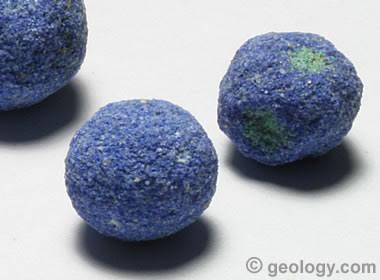
Azurite “Blueberries”: Small nodules of azurite, between five and ten millimeters across, that weathered out of a poorly-cemented sandstone near La Sal, Utah.
Making pigment from azurite was costly. During the Middle Ages it was difficult to mine, transportation was slow, and grinding and processing were slow and difficult. Azurite pigment was gradually replaced, starting in the 18th century, when man-made pigments such as “Prussian blue” and “blue verditer” were invented. These synthetic pigments are standardized products with uniform properties. That makes them predictable in their use. They are also less costly to produce.
Many paintings done during the Middle Ages, before azurite was replaced with Prussian blue, show deterioration of the blue color. Over time and exposure to the atmosphere and light, azurite slowly weathers to malachite. Much of the blue azurite pigment used during the Middle Ages now shows obvious signs of green malachite as a weathering product. This is another reason why man-made pigments are now used instead of azurite. Azurite pigment and paints are still available today and are easy to find. But they are mainly used by painters who want to employ historical methods in their work.
Mineral Collecting
Azurite is popular with mineral collectors. They appreciate its deep blue monoclinic crystals, nodular habit with interesting structures, and representative examples of its botryoidal and stalactitic habits. Excellent specimens can sell for hundreds, thousands, or tens of thousands of dollars depending upon their quality and size.
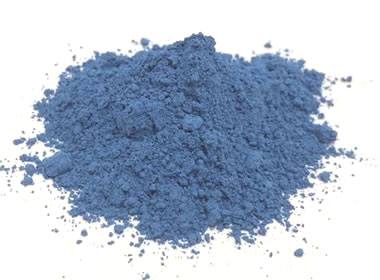
Azurite Pigment: High-purity azurite finely ground into a powder and ready for use as a pigment. Azurite has been used as a pigment for thousands of years. Today, synthetic pigments are used more than natural pigments. They are lower in cost and standardized in their properties.
The instability of azurite is a problem for collectors. If exposed to heat or high humidity, specimen surfaces will begin to weather to malachite. This causes a dull, faded or greenish appearance depending upon the severity of alteration. Valuable specimens are best stored in closed collection drawers where there is limited air circulation, darkness, and cool, stable temperatures.