Morganite has a color that ranges from slightly yellowish orange, to orange, to orangy pink, to pink, to slightly purplish pink. This color range appeals to many people and has an attractive appearance in rose gold jewelry mountings, which have also grown in popularity.
Trace amounts of manganese are the cause of natural color in morganite. Most morganite has a natural color that is very light, especially when it is cut into faceted gems of two carats or less. As a general guide, for best appearance, gems cut from morganite should be at least two carats in size.
This light-colored morganite is often treated with heat or irradiation to increase its color saturation. These treatments make the gems more appealing and marketable. Some of these treatments move the gem toward the pink side of morganite’s color range.
These morganite treatments are common, permanent, undetectable, and accepted in the marketplace. However, treated gems should always be sold with disclosure because many consumers have a strong preference for untreated gems. Customers who only want untreated gems should always ask the seller for information about treatments.
Morganite is a pleochroic gem. That means it has slightly different colors when viewed from different directions. It has a slightly richer color when viewed down its “c” crystallographic axis. Cutters who study their rough carefully, and orient their faceted stones with the c-axis perpendicular to the table of the cut gem, will produce stones that exhibit a richer, often pinker color when viewed in the face-up position.
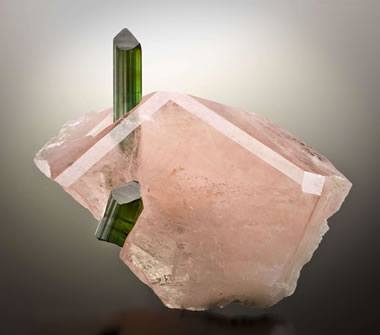
Morganite: An interesting specimen of morganite with tourmaline crystals from the Pederneira Mine in Minas Gerais, Brazil. This specimen has been nicknamed the “Sword in the Stone.” Approximately 13.8 x 8.0 x 11.7 centimeters in size. It is an exceptional display piece because of its size, color, crystal form, and artistic appeal; therefore, it is much more valuable as a mineral specimen than as gem-cutting rough.