Chrysoberyl is a rare beryllium aluminum oxide mineral with a chemical composition of BeAl2O4. It is sometimes confused with the silicate mineral known as beryl, which has a composition of Be3Al2Si6O18.
The main commercial use of chrysoberyl is as a gemstone. It excels in that use because of its high hardness – 8 1/2 on the Mohs hardness scale. The only gem minerals with a higher hardness are diamond and corundum (the mineral of ruby and sapphire).
A minor use of chrysoberyl is as a collector’s mineral. Well-formed crystals are valuable and highly desirable – especially those that exhibit twinning.
Although chrysoberyl contains beryllium, it is not mined as a source of beryllium. It is only found in small occurrences that cannot be mined at a profit.
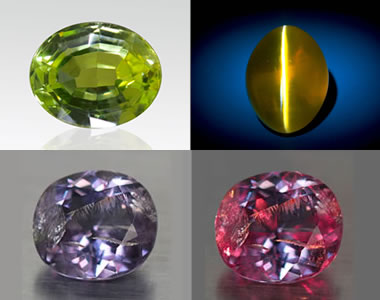
Varieties of Gem Chrysoberyl: Top left: a faceted oval of transparent green, nonphenomenal chrysoberyl, by Greg C. Grace / Alamy. Top right: the yellow oval cabochon known as the Maharani cat’s-eye chrysoberyl, by SBS Eclectic Images / Alamy. Bottom: a single stone of faceted color-change chrysoberyl in natural light (left) and in incandescent light (right), by Halyna Kubei / Alamy.