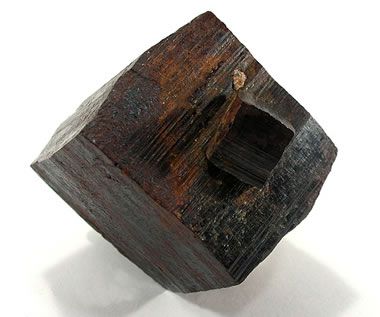
Limonite usually occurs as a secondary material, formed from the weathering of hematite, magnetite, pyrite, and other iron-bearing materials. Limonite is often stalactitic, reniform, botryoidal, or mammillary in habit, rather than crystalline. It also occurs as pseudomorphs and coatings on the walls of fractures and cavities.
Some limonite is found in stratified deposits where hydrous iron oxides form as precipitated sediment on the floor of shallow swamps, lakes, and marine environments. These can be of inorganic or biogenic origin.
Limonite often forms as a precipitate at springs and mine openings where acidic, iron-laden waters emerge from the subsurface. Most subsurface waters contain very little oxygen, and when they discharge to the surface, they often encounter oxygenated waters. Dissolved metals in the groundwater rapidly combine with the dissolved oxygen of the surface water to form a precipitate that falls onto the bed of the stream. This precipitate is a characteristic sign of acid mine drainage.
Limonite is very resistant to weathering and often accumulates as a residual deposit. It is often the main form of iron and colorant in lateritic soils.