Sometimes a mining company does not want to purchase a property because they are uncertain of the type, amount or quality of minerals that exist there. In these situations the mining company will lease the mineral rights or a portion of those rights.
A lease is an agreement that gives the mining company the right to enter the property, conduct tests and determine if suitable minerals exist there. To acquire this right the mining company will pay the property owner an amount of money when the lease is signed. This payment reserves the property for the mining company for a specific duration of time. If the company finds suitable minerals it may proceed to mine. If the mining company does not commence production before the lease expires, then all rights to the property and the minerals return to the owner.
When minerals are produced from a leased property, the owner is usually paid a share of the production income. This money is known as a “royalty payment.” The amount of the royalty payment is specified in the lease agreement. It can be a fixed amount per ton of minerals produced or a percentage of the production value. Other terms are also possible.
When entering into a lease agreement, the property owner must anticipate any activities that the lessee might do while exploring the property. This exploration might include drilling holes, opening excavations, or bringing machines and instruments onto the property. Defining what is allowed and what restoration is required is part of a good lease agreement.
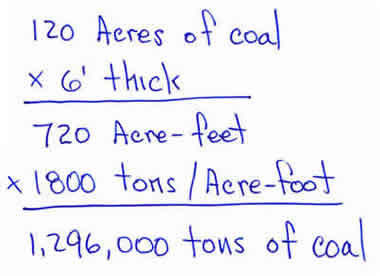
1) In this calculation we have a 120-acre property that is completely underlain by a coal seam with an average thickness of 6 feet. Multiplying the number of acres times the average thickness of the coal would yield the number of acre-feet of coal beneath the property.
2) It is known that one acre-foot of coal weighs about 1800 tons. Therefore if we multiply the number of acre-feet of coal beneath the property by 1800 tons/acre-foot, the result will be the number of tons of coal beneath the property.
The number of tons obtained in this calculation is the total tons below. The number of tons that can be recovered will be a much smaller number. Recovery rates for surface mining are often about 90%. Recovery rates for underground mining can be as low as 50% because pillars of coal must be left in the mine to support the roof.
A professional geologist or a state geological survey might be able to help you determine if coal seams exist beneath your property. They might also have an estimate of how thick those seams might be.