Below the surface, oil and gas have the ability to move through the rock. They can travel through tiny pore spaces – such as between the grains of sand in sandstone or through the tiny openings created by fractures. This mobility allows a well to drain oil or gas from adjacent lands. So, a well drilled on your land could drain gas from a neighbor’s land if the well was drilled sufficiently close to the property boundary.
Some states have recognized the ability of oil and gas to cross property boundaries underground. These states have produced regulations that govern the fair sharing of oil and gas royalties. These states generally require drilling companies to specify how oil and gas royalties will be shared among adjacent property owners when a permit for drilling is filed. The proposed sharing of royalties will be based upon what is known about the geometry of the oil or gas reservoir compared to the geometry of property ownership at the surface. This procedure is known as “unitization.”
Some states do not have rules for unitization of oil and gas royalties. Other states have them but only for wells that produce from certain areas or from certain depths. These rules can play a critical role in a leasing or resource development strategy. Some people tell stories about landmen saying “Lease to me now or we will drill your neighbor’s land and drain your gas without paying you a cent.” In some situations, an absence of state regulations allows this to occur. If you are contacted about leasing your mineral rights, you should contact an attorney for advice on how the laws of your state will apply to your property.
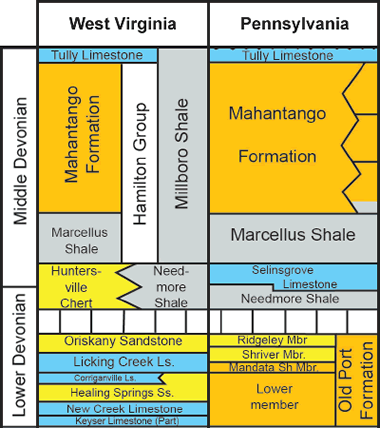
(Note: In Pennsylvania the rules for natural gas sharing change at certain depths below the surface and at certain positions in the stratigraphic column. See the section labeled “Stratigraphic Column” near the bottom of this page for more information. In some areas the rules used for sharing Marcellus Shale gas can be different from the rules used for sharing gas from the underlying Utica Shale. Consult with an attorney on how these might apply to your property.)
“Your oil or gas could be produced or captured from a well outside your property tract boundaries. In fact, your only protection is if your oil or gas property is subject to the Oil and Gas Conservation Law, 58 P.S. § 401.1 et seq. If so, the gas on your property could be included in a unitization or pooling order issued by the Commonwealth at the behest of a producer on a neighboring tract. That well operator would then have to pay you a production royalty based on your prorated share of the production from the well, depending on how much of your tract was deemed to be contributing to the well’s pool. This law applies to oil or gas wells that penetrate the Onondaga horizon and are more than 3,800 feet deep.”
Image by: Robert Milici and Christopher Swezey, 2006, Assessment of Appalachian Basin Oil and Gas Resources: Devonian Shale–Middle and Upper Paleozoic Total Petroleum System. Open-File Report Series 2006-1237. United States Geological Survey. View complete stratigraphy for other areas.