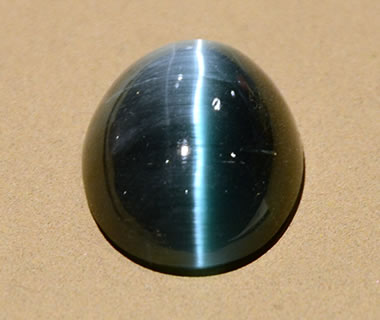
Tourmaline is one of many minerals that can be chatoyant when cut into a gem. “Chatoyant” is a gemological adjective used to describe minerals that exhibit a “cat’s-eye”. Chatoyant tourmalines contain thousands of tiny parallel tubes that have the ability to reflect light. When a tourmaline crystal filled with these tubes is properly cut as a cabochon, a line of bright light known as a cat’s-eye will be reflected from the dome of the cabochon. The proper orientation is obtained by cutting the cabochon with the tubes paralleling the base of the cabochon and crossing the long dimension of the cabochon at a right angle.
Cat’s-eye gems are fun to observe because the “eye” will move back and forth across the dome of the stone in three situations: 1) when the stone is moved under the light, 2) when the source of light is moved, and 3) when the head of the observer is moved.