Throughout its history, Earth has been repeatedly hit by large asteroids. When these asteroids strike the earth, extreme temperatures and pressures are produced. For example: when a six mile (10 kilometer) wide asteroid strikes the earth, it can be traveling at up to 9 to 12 miles per second (15 to 20 kilometers per second). Upon impact this hypervelocity object would produce an energy burst equivalent to many nuclear weapons and temperatures hotter than the sun’s surface.
The high temperature and pressure conditions of such an impact are more than adequate to form diamonds. This theory of diamond formation has been supported by the discovery of tiny diamonds around several asteroid impact sites. See Location 3 in the diagram at the top of the page.
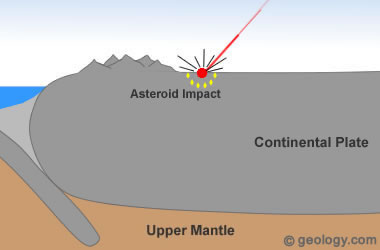
Tiny, sub-millimeter diamonds have been found at Meteor Crater in Arizona. Polycrystalline industrial diamonds up to 13 millimeters in size have been found at the Popigai Crater in northern Siberia, Russia.
Is coal involved? Coal could be present in the target area of these impacts and could serve as the carbon source of the diamonds. Limestones, marbles, dolomites, and other carbon-bearing rocks are more likely carbon sources than coal.