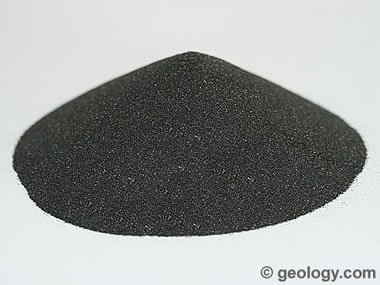
Ilmenite is a black mineral with a submetallic to metallic luster. With just a glance it can easily be confused with hematite and magnetite. The differentiation is easy. Hematite has a red streak, while ilmenite has a black streak. Magnetite is strongly magnetic, while ilmenite is not magnetic. Occasionally ilmenite is weakly magnetic, possibly from small amounts of included magnetite.
Ilmenite is usually more durable than the other minerals in the igneous rocks in which it is abundant. For that reason, the weathering debris produced during the weathering of these rocks is especially rich in ilmenite. Its relatively high specific gravity causes it to become concentrated in placer deposits like gold, gems, and other heavy minerals.
| Physical Properties of Ilmenite | |
| Chemical Classification | Oxide |
| Color | Black |
| Streak | Black |
| Luster | Metallic, submetallic |
| Diaphaneity | Opaque |
| Cleavage | None |
| Mohs Hardness | 5.5 to 6 |
| Specific Gravity | 4.7 to 4.8 |
| Diagnostic Properties | Streak; sometimes weakly magnetic. |
| Chemical Composition | Iron titanium oxide – FeTiO3. Sometimes has significant amounts of magnesium and manganese in solid solution with the iron to yield a composition of (Fe,Mg,Mn)TiO3 |
| Crystal System | Trigonal |
| Uses | The primary ore of titanium. A minor source of iron. Used to make titanium dioxide. |